European Accessibility Act 2025: The Ultimate SME Compliance Guide
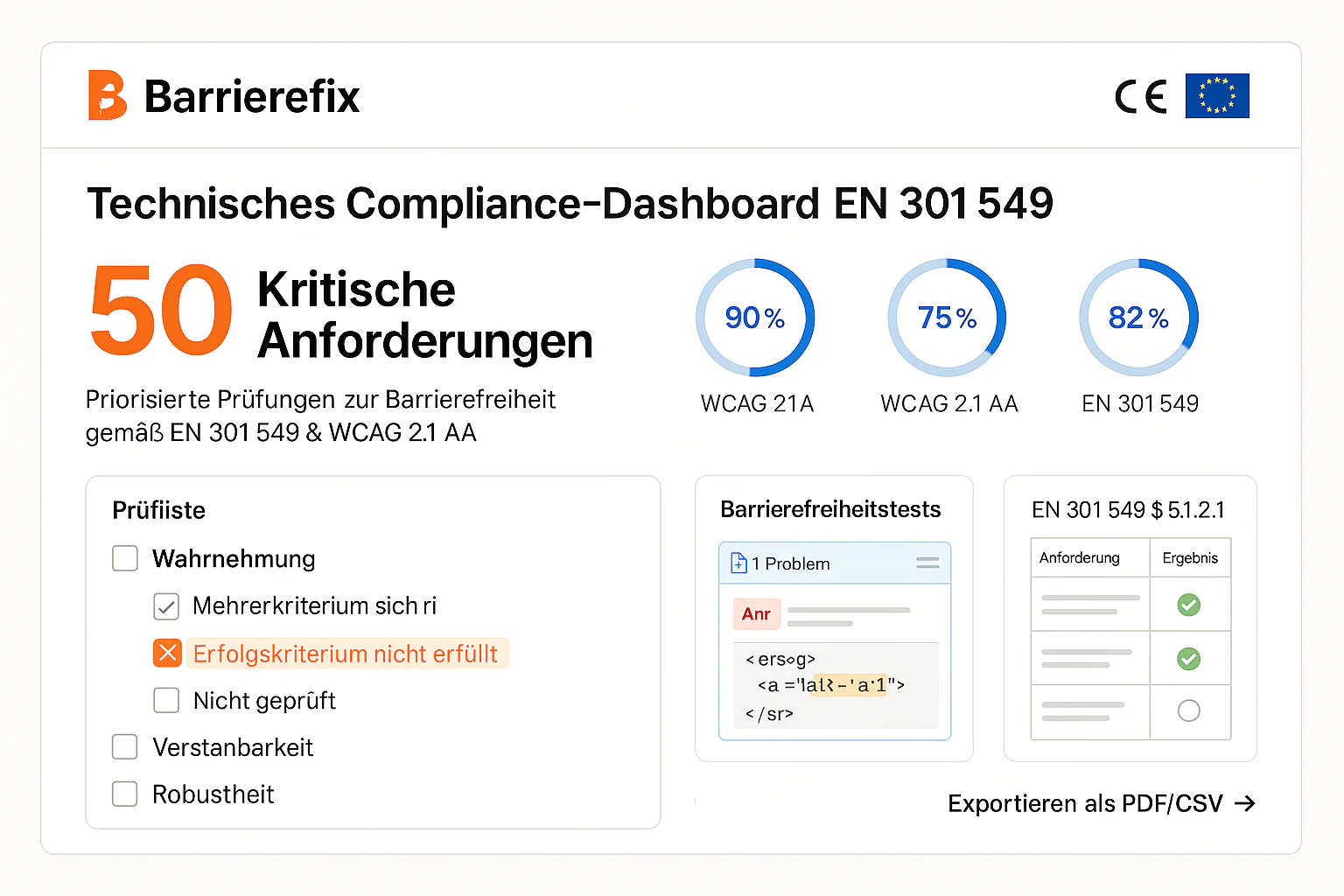
Note: While this article focuses on Germany's implementation of the European Accessibility Act (BFSG), these requirements apply across the EU under the European Accessibility Act (Directive 2019/882).
The European Accessibility Act (BFSG in Germany) will come into force on June 28, 2025, bringing mandatory accessibility requirements to private companies for the first time. While many businesses are still uncertain about who exactly is affected and what measures are required, the clock is ticking: only a few months remain until the deadline[1][2].
Important Notice: Countdown Running!
Starting June 28, 2025, EAA obligations apply without transition periods for websites and apps. Companies that don't act in time risk fines of up to €100,000.
What is the European Accessibility Act (BFSG)?
The BFSG is Germany's implementation of the European Accessibility Act (EAA) and makes accessibility mandatory for certain products and services in the private sector for the first time. Unlike BITV 2.0 (German Accessibility Regulation), which only affects public institutions, the EAA targets businesses that offer digital services to consumers[3].
Key Facts at a Glance:
- Effective Date: June 28, 2025 (no transition periods for digital services)
- Legal Basis: EU Directive 2019/882 (European Accessibility Act)
- Standard: EN 301 549 (based on WCAG 2.1 Level AA)
- Penalties: €10,000 to €100,000 for violations
- Affected: Private companies with consumer business
Who is Affected by the EAA? Complete Overview
✅ Fully Affected Businesses
E-Commerce and Online Retail:
- Online shops and marketplaces
- Booking platforms and travel portals
- Ticket sales and event platforms
- Service portals
Financial Services:
- Online banking and financial apps
- Insurance portals
- Payment providers for consumers
- Credit platforms
Telecommunications:
- Mobile and internet providers
- VoIP and messaging services
- Streaming platforms
- Social media platforms
🟡 Partially Affected Businesses
Microenterprises (Exception Rule): Service providers with fewer than 10 employees AND under €2 million annual revenue are exempt from the service directive[4].
⚠️ Important Exception: If microenterprises produce EAA-relevant products (hardware, software), the requirements still apply!
❌ Not Affected
- Pure B2B services without consumer business
- Internal company software
- Microenterprises below thresholds (services only)
- Already regulated public entities under BITV 2.0
💡 Unsure if you're affected? Use our free EAA check or book an initial consultation.
What Requirements Apply? The Technical Standard in Detail
The EAA references EN 301 549, the European standard for digital accessibility. This standard fully integrates WCAG 2.1 Level AA but goes beyond it in certain areas[5].
Core Areas of EN 301 549:
1. Web Content (based on WCAG 2.1 Level AA):
- All 50 success criteria Level A and AA
- Keyboard accessibility and focus management
- Color contrasts minimum 4.5:1
- Alternative text for all non-text content
- Semantic HTML structure
2. Additional EN 301 549 Requirements:
- Biometric Systems: Alternative authentication
- Document Formats: Accessible PDFs and Office documents
- Hardware Interfaces: For physical terminals
- Telecommunications: VoIP and video communication
The Most Important WCAG Areas for Businesses:
| Principle | Examples | Common Issues |
|---|---|---|
| Perceivable | Alt texts, contrasts, captions | Missing image descriptions |
| Operable | Keyboard navigation, focus | No skip links |
| Understandable | Clear language, error help | Unclear forms |
| Robust | Valid HTML code | Incompatible assistive technologies |
Timeline: When Does What Apply? The EAA Roadmap
📅 June 28, 2025 - Immediate Start
- Websites and mobile apps: No transition periods!
- Online shops and e-commerce: Full compliance required
- Digital services: Banking, booking, streaming etc.
📅 2030 - Existing Contracts
- Running service contracts must be adapted
- Existing customers receive accessible services
📅 2040 - Hardware Terminals
- Self-service terminals (ATMs, tickets etc.)
- Longest transition time due to hardware cycles
No Transition Periods for Websites!
Unlike hardware, websites and apps have no transition periods. From day one, all new and existing digital offerings must meet the requirements.
Fines and Enforcement: What Happens with Violations?
The EAA provides substantial penalties for non-compliance. Enforcement is carried out by state authorities, which can conduct both random and complaint-based inspections[6].
Fine Framework According to BFSG §37:
| Violation | Fine Range | Examples |
|---|---|---|
| Lack of Accessibility | €10,000 - €100,000 | Inaccessible website/app |
| Missing Information | €10,000 - €50,000 | No conformity declaration |
| Refusal to Cooperate | €20,000 - €100,000 | No response to inspection |
Additional Consequences:
- Distribution Bans: Complete blocking of online offering
- Warnings: From competitors and associations
- Reputation Damage: Negative reporting
- Revenue Loss: From blocked services
⚖️ Legal Reality: First Proceedings Already Underway
Even before the official start, consumer protection associations and law firms are collecting cases for the first EAA proceedings. Companies that don't prepare will be among the first targets.
Source: Monitoring of German law firms in consumer protection
The Most Common EAA Myths Debunked
Myth 1: "Accessibility overlays make us compliant"
❌ False: Overlay tools like AccessiBe or UserWay can detect at most 20-30% of WCAG problems and often create new barriers. Over 900 companies with overlays were sued in 2023[7].
✅ Correct: Only native accessibility integrated into code meets EAA standards.
Myth 2: "WCAG 2.2 is required for EAA"
❌ False: EAA explicitly refers to WCAG 2.1 Level AA.
✅ Correct: WCAG 2.2 is recommended for better mobile accessibility, but not legally required.
Myth 3: "Small businesses are completely exempt"
❌ False: The microenterprise exception only applies to service providers, not product manufacturers.
✅ Correct: A 5-person software company with its own apps must make them accessible.
Your EAA Compliance Roadmap: Next Steps
Phase 1: Assessment (Weeks 1-2)
- Check if affected: Which of your services fall under EAA?
- Analyze current state: WCAG audit of your website
- Risk assessment: Fine potential and compliance gap
- Plan resources: Set budget and timeline
Phase 2: Quick Wins (Weeks 3-4)
- Add alt texts: Provide all images with descriptions
- Check color contrasts: Use contrast checker
- Test keyboard navigation: All functions accessible without mouse?
- Optimize forms: Improve labels and error messages
Phase 3: Structural Implementation (Weeks 5-12)
- Semantic HTML: Correctly mark up headings, lists, tables
- Implement ARIA labels: For dynamic content and widgets
- Focus management: Visible focus indicators and logical order
- Testing routine: Automated + manual tests with screen readers
Phase 4: Documentation & Monitoring
- Conformity declaration: Document EAA compliance in writing
- Feedback mechanism: Accept barrier reports from users
- Regular audits: Quarterly reviews
- Team training: Educate developers and content teams
💡 BarriereFix Tip: The 80/20 Approach
80% of WCAG conformance can be achieved with 20% effort if you set the right priorities. Our EAA Express Service focuses on these quick wins.
Resources and Further Information
Official Sources
- German Federal Competence Center for Accessibility: Official EAA information
- BFSG-Gesetz.de: Complete legal text and explanations
- EN 301 549 Standard: Technical standard (English)
Practical Tools
Frequently Asked Questions (FAQ)
Must my website be 100% accessible on June 28, 2025?
Yes, there are no transition periods for digital services. Your website must meet EN 301 549 standards, which correspond to WCAG 2.1 Level AA, from day one.
How do I know if my company is affected?
You are affected if you offer digital services to consumers (e-commerce, banking, booking etc.). The microenterprise exception only applies to service providers with under 10 employees and under €2 million revenue.
Can I become EAA-compliant with an accessibility overlay?
No. Overlay tools like AccessiBe can only detect 20-30% of WCAG problems and often lead to new barriers. Over 900 companies with overlays were sued in 2023.
What happens if I don't meet EAA requirements?
Fines of €10,000-€100,000, possible distribution bans and reputation damage. State authorities conduct both random and complaint-based inspections.
Is WCAG 2.2 required for EAA compliance?
No, EAA refers to WCAG 2.1 Level AA. WCAG 2.2 is recommended for better mobile accessibility, but not legally required.
What costs will my company face?
Costs vary greatly depending on website complexity. Simple websites can be made compliant for €5,000-€15,000 (approx. $5,400-$16,200), complex e-commerce systems cost €25,000-€100,000 (approx. $27,000-$108,000). However, ROI is demonstrably positive.
Does EAA also apply to B2B companies?
Only if you also do consumer business. Pure B2B services without end customer business are not affected.
How does EAA differ from BITV 2.0?
BITV 2.0 (German Accessibility Regulation) applies to public entities, EAA to private companies with consumer business. EAA has stricter enforcement with higher fines.
Next Steps: Act Now Instead of Waiting
The EAA is not a bureaucratic hurdle, but an opportunity: Companies that act now gain a competitive advantage and unlock new target groups. The time for procrastination is over – June 28, 2025 is coming inevitably.
Your next step: Let's assess together where you stand and how you can become compliant in time. Our EAA Express Service gets you to your goal in 8-12 weeks.
Kostenlose BFSG-Erstberatung
Related Articles: Deepen Your EAA Knowledge
This comprehensive guide provides you with the perfect introduction. For specific aspects, we've created detailed individual articles:
- Who is Affected by the EAA? The €2 Million Threshold Explained
- When Does What Apply? The EAA Timeline 2025-2040
- EAA Fines: €10,000 to €100,000 - What Really Threatens?
- EN 301 549 for Websites: The 50 Most Important Requirements
- WCAG 2.1 vs 2.2 vs 2.3: Which Standard Applies in 2025?
- Overlay Myth Exposed: Why AccessiBe & Co. Don't Help
- German Federal Competence Center for Accessibility: Resources & Funding
- EAA vs. BITV 2.0: Private vs. Public Explained
Each article contains specific FAQs, checklists and additional resources for your compliance journey.
Free audit of your website
Let us check your website for accessibility – free and non-binding
Topics:
BFSG-ClusterVertiefen Sie Ihr Wissen
Weitere Artikel
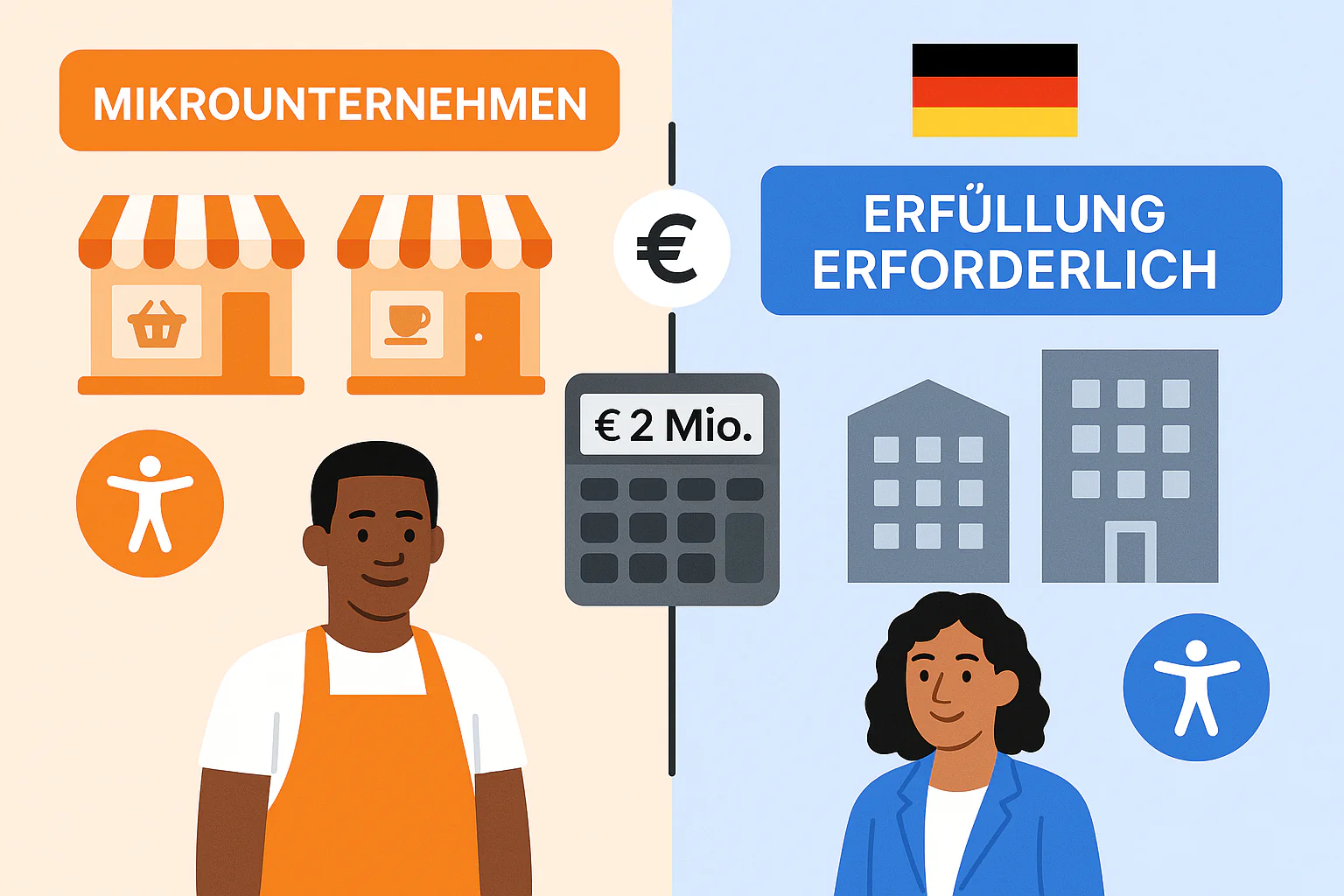
Who is Affected by the EAA? The €2 Million Threshold Explained
Detailed analysis of EAA applicability: microenterprise exception, thresholds, special cases. Clear answers for SMEs about the €2 million threshold.
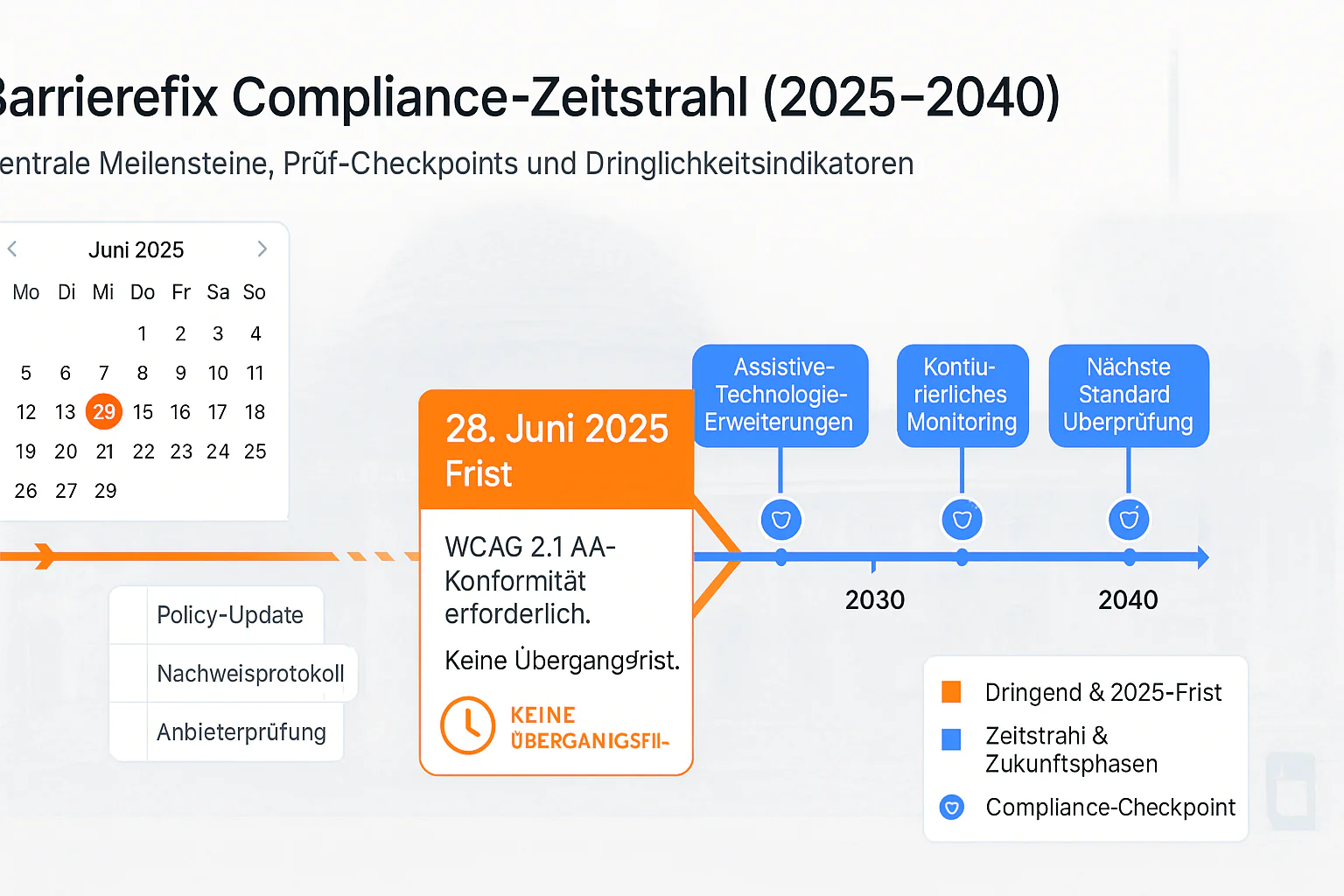
When Does What Apply? The EAA Timeline 2025-2040
Complete EAA timeline: June 28, 2025 for websites, 2030 for existing contracts, 2040 for terminals. All deadlines, transition periods and key dates at a glance.
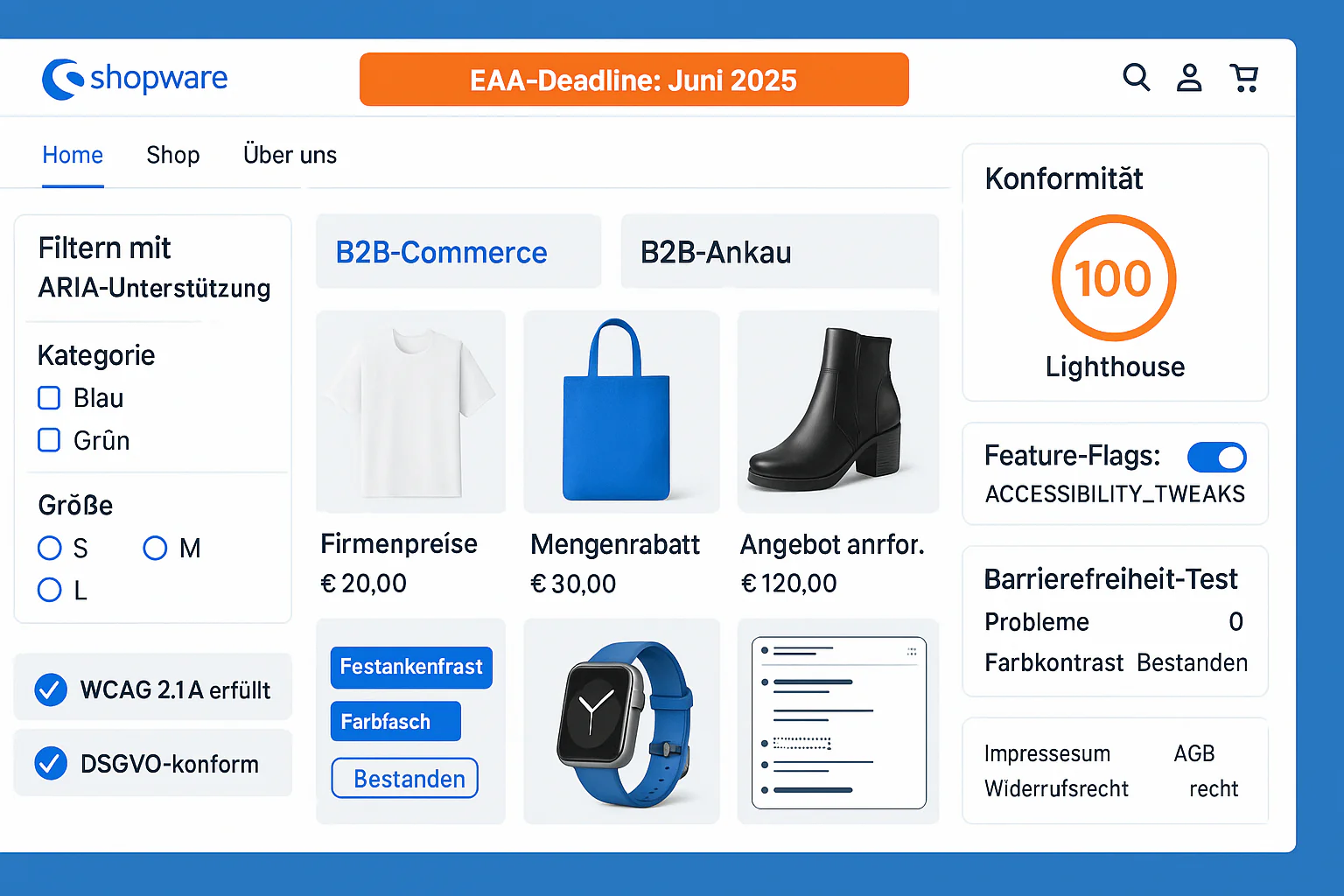
Shopware 6 Accessibility: EAA Compliance Guide for E-Commerce
Shopware 6.7 Accessibility Guide 2025: Built-in WCAG 2.1 Features, EAA Compliance, B2B Features - Achieving Perfect 100/100 Lighthouse Score.