EAA Fines: €10,000 to €100,000 - What Really Threatens?
Note: While this article focuses on Germany's implementation of the European Accessibility Act (BFSG), similar enforcement mechanisms apply across the EU under the European Accessibility Act (Directive 2019/882).
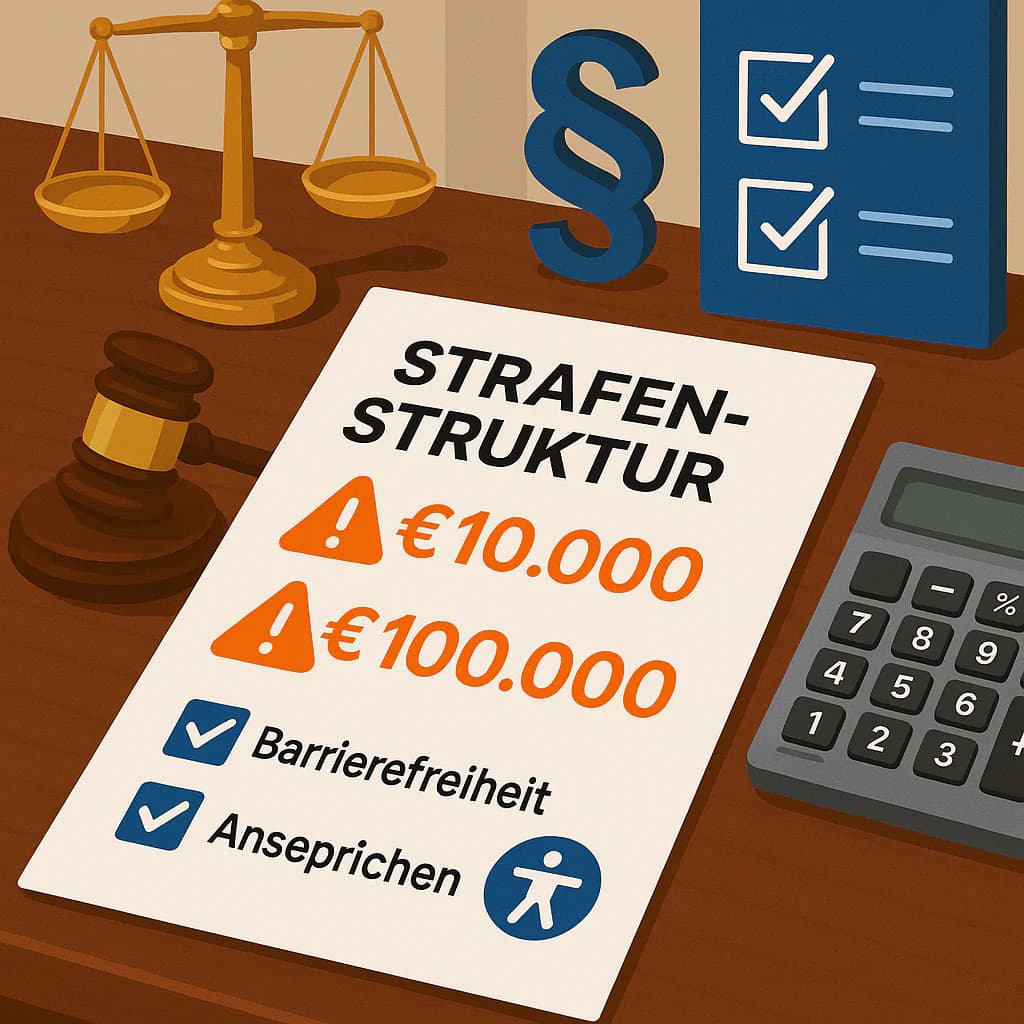
EAA fines are not just paper tigers - they are real and will be enforced. With penalties ranging from €10,000 to €100,000 (approx. $10,800-$108,000) per violation and additional distribution bans, non-compliance costs have the potential to put companies in existential difficulties. This analysis shows what really threatens, who controls, and how you can protect yourself[1][2].
Reality Check: First Proceedings Already in Preparation
Specialized law firms and consumer protection associations are already collecting cases for the first EAA proceedings after June 28, 2025. Unprepared companies will be among the first targets.
The EAA Fine Matrix: What Does Each Violation Cost?
The EAA defines a clear fine framework in § 37, but the specific amounts depend on the severity of the violation[3]:
Fine Categories According to BFSG § 37 Para. 2:
| Violation Category | Fine Range | Frequency | Examples |
|---|---|---|---|
| Lack of Accessibility | €10,000 - €100,000 | Very high | Website without alt texts, no keyboard navigation |
| Incomplete Information | €10,000 - €50,000 | High | Missing conformity declaration, incomplete documentation |
| Refusal to Cooperate | €20,000 - €100,000 | Medium | No response to authority inquiry, refused information |
| Repeat Offenders | €50,000 - €100,000 | Low | Multiple violations despite warning |
Additional Sanctions Beyond Fines:
- Distribution Bans: Complete blocking of online offering
- Coercive Measures: Authority-mandated corrections
- Reputation Damage: Public announcement of violations
- Civil Law Warnings: From competitors and associations
Who Controls? The Enforcement Landscape
Responsible Authorities (by German Federal States):
Baden-Württemberg: Regional councils Bavaria: Bavarian State Ministry for Digital Affairs Berlin: Senate Department for Integration, Labor and Social Affairs Brandenburg: Ministry for Social Affairs, Health, Integration Bremen: Senator for Social Affairs, Youth, Integration Hamburg: Social Authority Hamburg Hesse: Hessian Ministry for Social Affairs and Integration [... additional states accordingly]
Authority Control Instruments:
- Random Checks: Automated scans of large websites
- Complaint-Based Inspections: Citizen reports and tips
- Industry Focus: Focus on critical sectors (banking, e-commerce)
- Follow-up Controls: Review after complaints
Insider Info: Authority Preparation Already Underway
Our research shows: State authorities are already equipping themselves with specialized teams. Automated testing tools are ordered, inspection personnel are being trained. Enforcement will be taken seriously.
Concrete Violation Scenarios and Their Costs
Scenario 1: Standard E-Commerce Website (Medium Deficiencies)
Identified Violations:
- 40% of images without alt texts
- Color contrast at 3.2:1 (instead of 4.5:1)
- No keyboard navigation in checkout
- Forms without correct labels
Probable Fine: €15,000 - €25,000 (approx. $16,200-$27,000) Reasoning: Medium severity, first inspection Additional Costs: €8,000 - €15,000 (approx. $8,600-$16,200) for subsequent remediation
Scenario 2: Online Banking with Severe Deficiencies
Identified Violations:
- Completely inaccessible login screen
- Screen reader cannot read account balances
- Transfer form without error messages
- No conformity declaration available
Probable Fine: €60,000 - €100,000 (approx. $64,800-$108,000) Reasoning: Critical infrastructure, severe deficiencies Additional Costs: €50,000 - €120,000 (approx. $54,000-$129,600) for complete overhaul
Scenario 3: Startup App with Refusal to Cooperate
Identified Violations:
- App not accessible
- No response to authority inquiry after 4 weeks
- Excuses and delay tactics
- No recognizable efforts to improve
Probable Fine: €80,000 - €100,000 (approx. $86,400-$108,000) Reasoning: Refusal to cooperate is severely punished Additional Costs: Distribution ban until compliance
Scenario 4: Repeat Offender After Warning
Identified Violations:
- Already warned in 2024, but nothing improved
- Inspected again after EAA start: same problems
- Despite fine notice, no changes made
- Ignored requirements and deadlines
Probable Fine: €100,000 (maximum, approx. $108,000) Reasoning: Deliberate disregard, repetition Additional Costs: Permanent distribution ban possible
Fine Assessment: What Criteria Do Authorities Use?
Aggravating Factors (higher fines):
- Company Size: Large corporations pay more than SMEs
- Revenue: Percentage calculation on annual revenue
- Critical Areas: Banking, healthcare, education are assessed more strictly
- Intent: Deliberate disregard despite warnings
- Repetition: Multiple violations in short time
- Refusal to Cooperate: No cooperation with authorities
Mitigating Factors (lower fines):
- First Offender: First inspection, previously unblemished
- Quick Remediation: Immediate corrections after complaint
- Microenterprises: Very small businesses (but only for service providers)
- Partial Compliance: Recognizable efforts, but not complete
- Cooperative Attitude: Open communication with inspection authorities
- Self-Reporting: Self-disclosure of problems before inspection
💡 Insider Tip: The "Golden Hour" After Inspection
Authorities often grant a short remediation period (typically: 2-4 weeks) before issuing a fine notice. Companies that become fully compliant during this time can often expect significantly reduced penalties.
Requirement: Cooperative attitude and demonstrable, complete remediation of all deficiencies.
Comparison: EAA vs. GDPR Fines
| Aspect | EAA | GDPR |
|---|---|---|
| Maximum | €100,000 | €20 million / 4% annual revenue |
| Frequency | High (almost all websites affected) | Medium (only for data protection violations) |
| Inspection Effort | Low (automated tests) | High (complex document review) |
| Enforcement | Very likely | Only for severe cases |
| Authorities | All states in parallel | Only data protection authorities |
| Publicity | High media attention | Routine reports |
Conclusion: EAA fines are lower, but much more likely than GDPR penalties.
Legal Remedies and Appeal Options
Objection to Fine Notice:
- Deadline: 2 weeks after service
- Form: Written with justification
- Success Chances: Good for formal errors, poor for material violations
- Costs: Legal fees + court fees (€5,000 - €15,000 / approx. $5,400-$16,200)
Typical Objection Grounds:
- Procedural Errors: Wrong jurisdiction, formal errors
- Factual Errors: Incorrect assessment of accessibility
- Proportionality: Fine too high for company size
- Statute of Limitations: For very old violations
Realistically Assess Success Chances:
- Very Good (80%): Obvious authority errors
- Good (60%): Fine significantly above industry standard
- Medium (40%): Dispute over interpretation of WCAG criteria
- Poor (10%): Clear violations, appropriate fine amount
Prevention Strategies: How to Minimize Your Risk
Immediate Measures (next 4 weeks):
- WCAG audit of your complete website
- Quick wins implementation: Alt texts, contrasts, keyboard navigation
- Legal consultation for your specific case
- Compliance team assemble and train
Medium-Term Protection (until June 2025):
- Complete WCAG 2.1 Level AA implementation
- Automated testing integrated into development workflow
- User testing with people with disabilities
- Documentation and conformity declaration creation
Long-Term Compliance (from July 2025):
- Monitoring system for continuous oversight
- Incident response plan for quick error resolution
- Regular audits (quarterly recommended)
- Training program for all relevant employees
✅ The "Fine Firewall": 5-Point Protection
1. Complete WCAG Compliance: Fulfill 100% of criteria
2. Proactive Communication: Publish conformity declaration prominently
3. Feedback Mechanism: Users can report barriers
4. Quick Response: Fix reported problems in 48h
5. Continuous Monitoring: Weekly automated tests
Case Studies: Lessons Learned from Other Countries
USA: ADA Lawsuits as Warning
- 2023: Over 4,000 digital accessibility lawsuits
- Average Settlement: $50,000 - $150,000
- Trend: 30% increase per year since 2018
- Target Group: Especially e-commerce and financial services
UK: Public Sector Bodies Regulations
- First Fines 2022: £50,000 for University of Oxford
- Enforcement Rate: 95% of cited entities improved
- Insights: Early compliance is significantly cheaper than remediation
France: Code de la consommation
- Pilot Phase 2024: 200 companies inspected
- Fine Rate: 85% of inspected received penalties
- Average: €35,000 per proceeding
- Special Feature: Consumer protection associations very active in reporting
Frequently Asked Questions About EAA Fines
Can I be held personally liable as a managing director?
Generally, the company is liable, not the person. Only in case of intent or gross negligence by management is personal liability conceivable.
Is there a statute of limitations for EAA violations?
Yes, administrative offenses expire after 2 years. The period begins with the end of the violation, not with discovery.
Can competitors warn us for EAA violations?
Yes, the German Competition Act (UWG) allows competitive warnings for illegal behavior. These come in addition to administrative fines.
What happens with repeated violations?
Repeat offenders receive significantly higher fines and risk distribution bans. Authorities maintain "repeat offender lists."
Are international companies safe from German fines?
No, if they serve German consumers. EU-wide enforcement agreements make foreign providers reachable too.
Can I deduct fines for tax purposes?
No, fines are not tax-deductible. Costs for compliance measures, however, are.
How quickly will inspections occur after June 28, 2025?
First inspections are already planned for July/August 2025. Large e-commerce providers and financial services are at the top of the lists.
Is installment payment available for high fines?
In exceptional cases yes, if the fine would threaten economic existence. This must be requested and justified in writing.
Cost-Benefit Calculation: Compliance vs. Fine Risk
Example Calculation for Medium Online Shop (€10 million revenue):
Compliance Costs:
- WCAG audit: €8,000 (approx. $8,600)
- Implementation: €35,000 (approx. $37,800)
- Ongoing Maintenance: €12,000/year (approx. $12,960/year)
- Total (3 years): €79,000 (approx. $85,320)
Non-Compliance Risk:
- Fine Probability: 60% in first 3 years
- Average Fine: €45,000 (approx. $48,600)
- Subsequent Implementation: €55,000 (approx. $59,400) (more expensive than proactive)
- Reputation Damage: €100,000 (approx. $108,000) (estimated)
- Expected Loss: €120,000 (approx. $129,600)
Conclusion: Compliance is 51% cheaper than non-compliance (€79k vs. €120k)
What You Should Do Now
EAA fines are a serious threat, but also a clear opportunity for prepared companies. The next months will decide whether you belong to the winners or losers of the new regulation.
Our urgent recommendation: Act immediately. Every day of delay increases your financial risk and worsens your negotiating position in fine proceedings.
Further EAA Articles:
Free audit of your website
Let us check your website for accessibility – free and non-binding
Topics:
Weitere Artikel
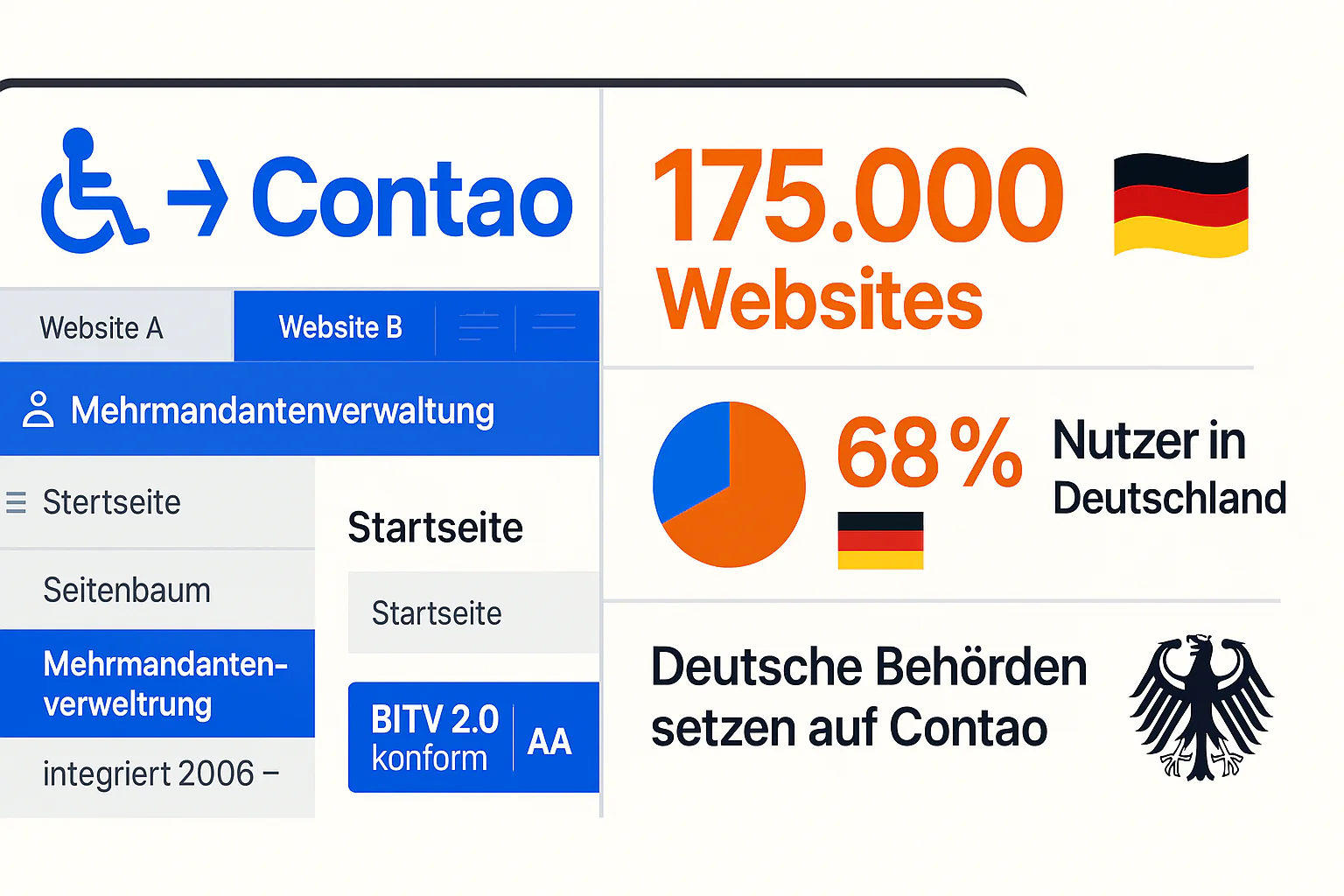
Contao CMS BITV Compliance: German Market Leader
Contao CMS Accessibility Guide 2025: Native BITV 2.0 Compliance, German Extensions, Multi-Site Management - 175,000 Websites worldwide.
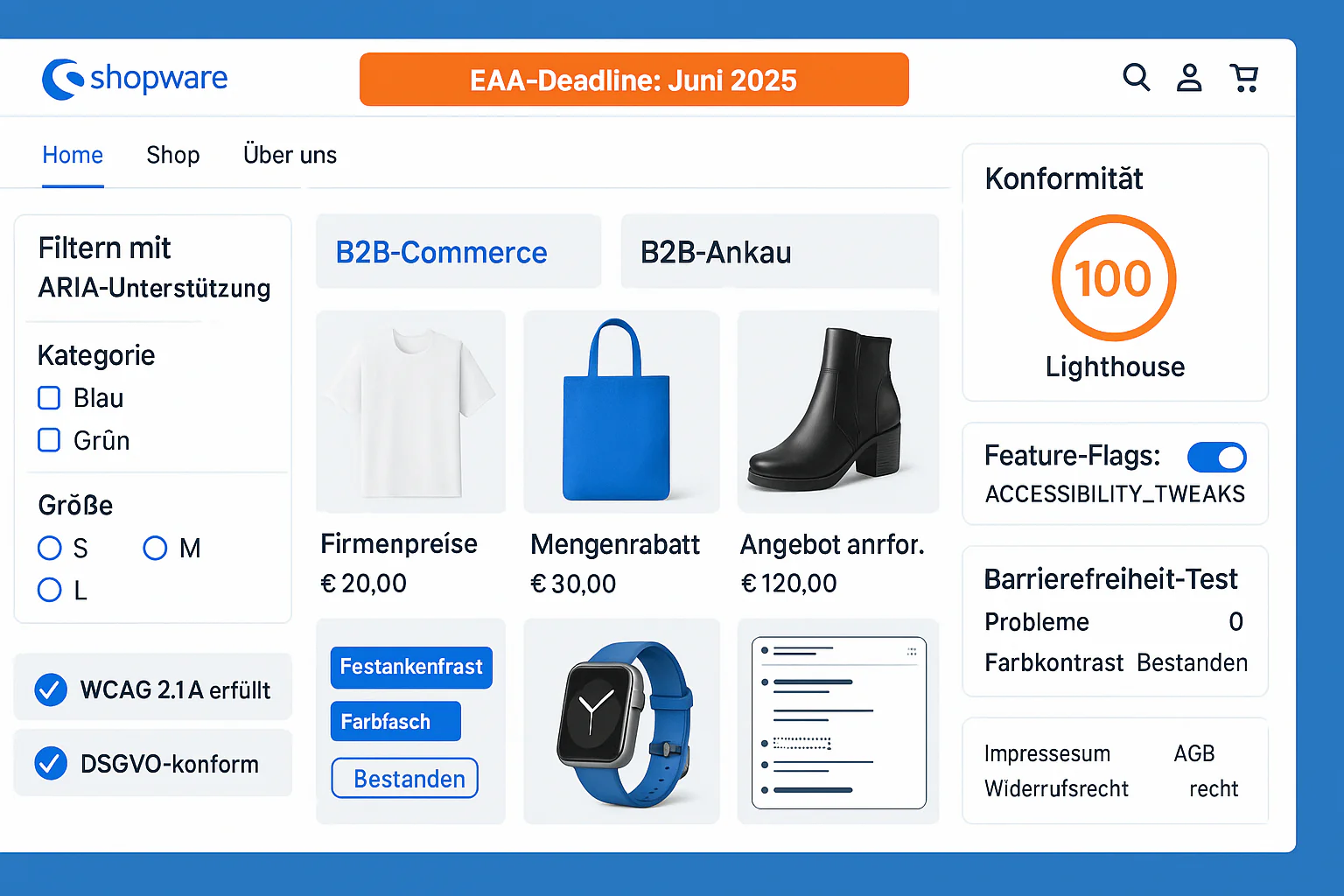
Shopware 6 Accessibility: EAA Compliance Guide for E-Commerce
Shopware 6.7 Accessibility Guide 2025: Built-in WCAG 2.1 Features, EAA Compliance, B2B Features - Achieving Perfect 100/100 Lighthouse Score.
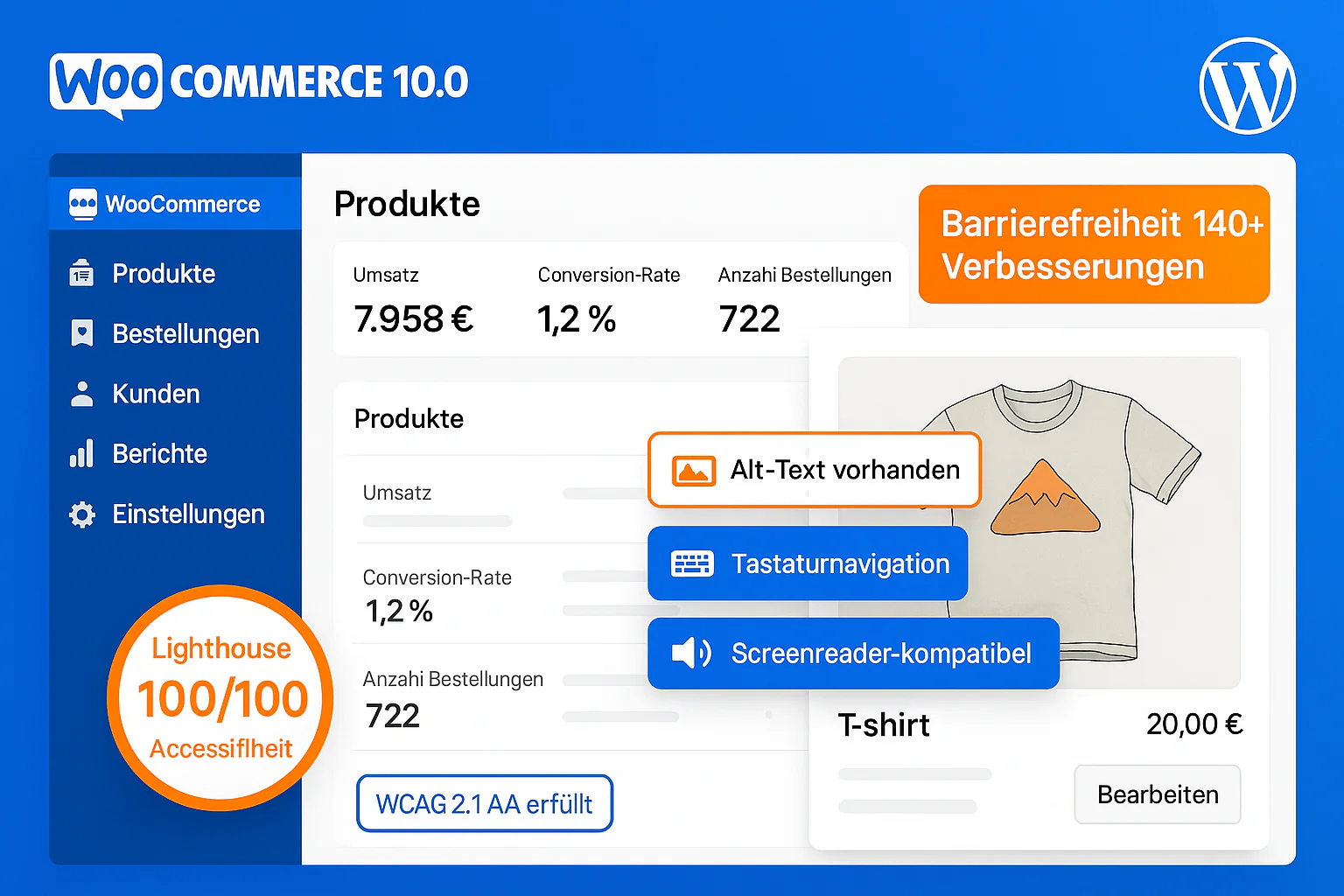
WordPress Accessible Product Page: WooCommerce WCAG Guide
WooCommerce 10.0 WCAG 2.2 Compliance Guide 2025: Themes, Plugins, Checkout, Payment Gateways - Properly Configuring 140+ Accessibility Features.