EAA vs. BITV 2.0: Private vs. Public Explained
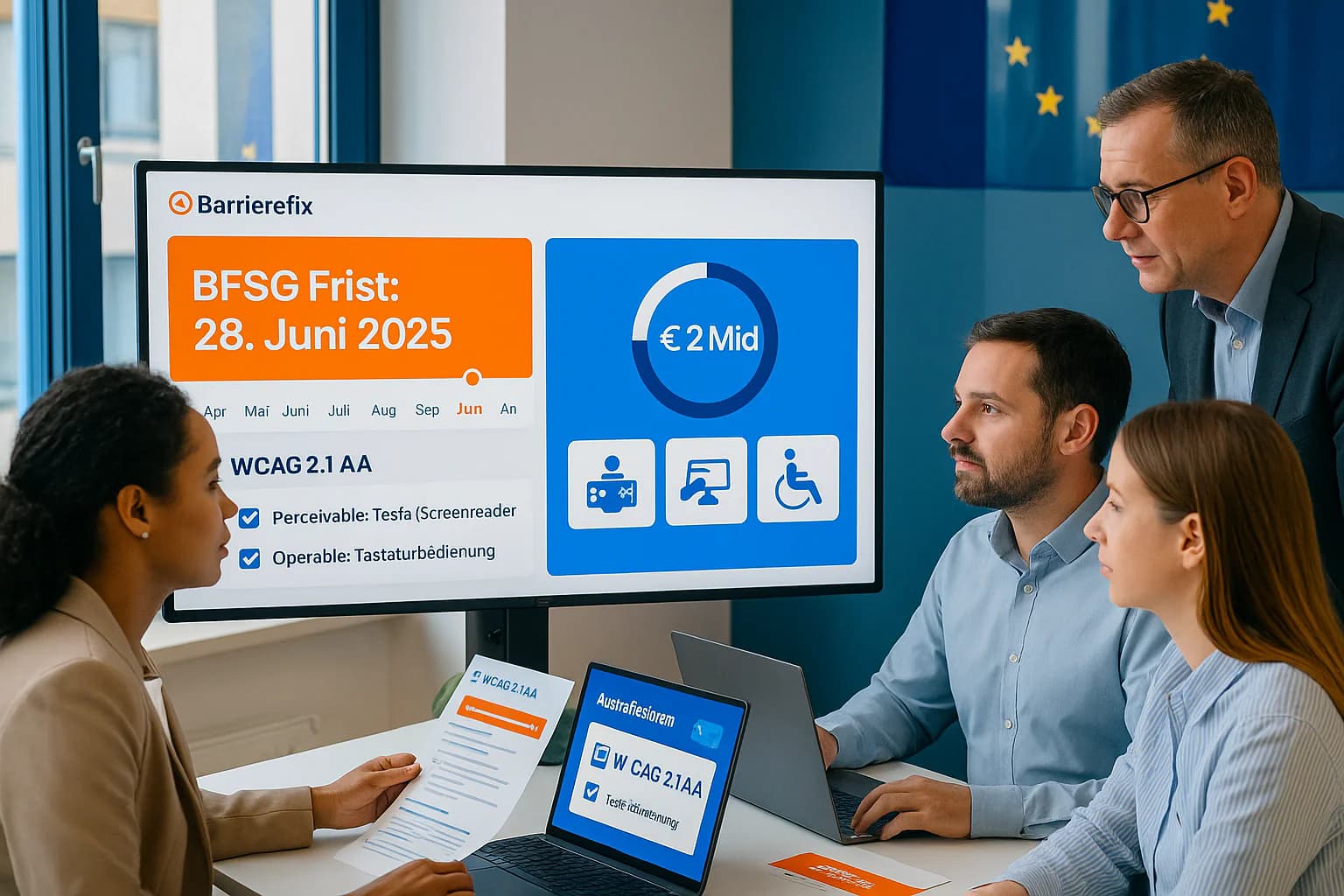
Note: While this article focuses on Germany's dual accessibility system (BFSG for private sector, BITV 2.0 for public sector), the European Accessibility Act applies uniformly across all EU member states for private companies.
Germany has a two-track accessibility system: BITV 2.0 (German Accessibility Regulation) for public entities since 2011, EAA (BFSG) for private companies from 2025. These parallel structures lead to confusion for companies serving both public and private customers. Which standards apply where? When do the requirements overlap? And what does this mean for hybrid organizations like public companies or PPP projects? This detailed analysis brings clarity to Germany's dual accessibility system[1][2].
Quick Orientation: Who is Subject to Which Law?
EAA (BFSG): Private companies with consumer business (B2C sector)
Overlap: With mixed business models, both standards often apply
The Two Pillars of German Accessibility
Germany regulates digital accessibility through two separate legal frameworks:
BITV 2.0: The Public Sector (since 2011)
- Full Name: Barrier-Free Information Technology Regulation
- Legal Basis: § 12d Disability Equality Act (BGG)
- Scope: Federal public entities, later also states
- Standard: WCAG 2.1 Level AA (since 2018 update)
- Deadlines: 2018 new websites, 2020 all existing websites
EAA (BFSG): The Private Sector (from 2025)
- Full Name: European Accessibility Act (Barrierefreiheitsstärkungsgesetz in German)
- Legal Basis: EU Directive 2019/882 (European Accessibility Act)
- Scope: Private companies with consumer business
- Standard: EN 301 549 (= WCAG 2.1 Level AA + additions)
- Deadline: June 28, 2025 (no transition periods for digital services)
Scopes: Who is Subject to Which Law?
BITV 2.0 Obligated: The Public Sector
Clearly BITV 2.0-Required:
- Federal Agencies: Ministries, federal offices, subordinate agencies
- State Level: State governments, state parliaments (according to respective state BITV)
- Municipalities: Cities, communities, counties
- Educational Institutions: Public schools, state universities
- Justice: Courts, public prosecutors, notaries
- Social Insurance: Health insurance, pension insurance, professional associations
Public Companies (more complex):
- 100% state-owned: Deutsche Bahn AG, Bundesdruckerei - BITV 2.0-required
- Mixed public-private: Different depending on business area
- Municipal Companies: Utilities, public transport - mostly BITV 2.0
EAA-Obligated: The Private Sector
Clearly EAA-Required:
- E-Commerce: Online shops, marketplaces, booking portals
- Financial Services: Private banks, insurance, FinTech
- Telecommunications: Mobile, internet providers, streaming services
- Private Services: Consulting, software, healthcare
- Media and Entertainment: Private TV stations, gaming, social media
Exceptions and Border Cases:
- Microenterprises: < 10 employees + < €2 million revenue (service providers only, not product manufacturers)
- Pure B2B Providers: Not affected unless they also have B2C business
- Non-Profit Organizations: EAA-required if they conduct consumer business
Gray Zone: Hybrid Organizations
Public companies with B2C business (e.g., Deutsche Post, Telekom shares) can be subject to both BITV 2.0 and EAA - depending on business area. Solution: Usually the stricter standard is applied.
Technical Standards Compared
BITV 2.0: WCAG 2.1 Level AA "Pure"
Reference Standard:
- WCAG 2.1 Level AA: All 50 success criteria mandatory
- Direct Adoption: Without additional or deviating requirements
- German Translation: Available, but original English version is authoritative
- Updates: Automatic adoption of new WCAG versions (currently still 2.1)
Special BITV 2.0 Requirements:
- Sign Language: Videos in German Sign Language (DGS)
- Easy Language: Additional information in simplified language
- Accessibility Declaration: Standardized format required
- Feedback Mechanism: Contact option for barrier reports
EAA (BFSG): EN 301 549 (WCAG Plus)
Reference Standard:
- EN 301 549 v3.2.1: Fully integrates WCAG 2.1 Level AA
- Additional Requirements: Biometrics, documents, hardware integration
- EU-Wide Harmonization: Same standard in all EU member states
- Business Focus: Practice-oriented implementation for private companies
EN 301 549 Specifics Beyond WCAG:
- Chapter 10: Accessible documents (PDFs, Office files)
- Chapter 5: Biometric systems and alternatives
- Chapter 12: Documentation and support services
- Chapter 13: Video telephony and ICT with video communication
Detailed Standard Comparison
| Aspect | BITV 2.0 | EAA (BFSG) |
|---|---|---|
| Core Standard | WCAG 2.1 Level AA | EN 301 549 (incl. WCAG 2.1) |
| Success Criteria | 50 (25 Level A + 25 Level AA) | 50 + approx. 15 additional |
| Documents | Recommended | Mandatory (Chapter 10) |
| Biometrics | Not covered | Mandatory alternatives |
| Hardware | Only assistive technologies | Terminals, kiosks etc. |
| Mobile Apps | Only if public-law | All B2C apps |
| Videos | German Sign Language mandatory | Captions sufficient |
| Easy Language | Recommended for complex content | Not explicitly required |
| Testing Methods | WCAG-EM procedure | EN 301 549-compliant testing |
| Monitoring | Annual oversight | Random inspections |
Enforcement and Sanctions
BITV 2.0 Enforcement: Federal Structure
Monitoring Bodies:
- Federal: Federal Monitoring Body for Accessibility of Information Technology
- States: Each with own monitoring bodies (16 different ones)
- Municipalities: Integration into existing oversight structures
Enforcement Mechanisms:
- Monitoring: Annual automated reviews + random samples
- Complaints: Citizen reports via feedback mechanism
- Sanctions: Rarely fines, mostly administrative orders
- Publicity: Monitoring reports are published
Sanction Reality with BITV 2.0:
- Fines: Very rarely imposed (< 10 cases Germany-wide since 2018)
- Measures: Mostly improvement orders with deadlines
- Compliance Rate: Approx. 65% at public entities (as of 2024)
EAA Enforcement: Centrally Coordinated, Federally Enforced
Enforcement Authorities:
- States: Market surveillance authorities of the 16 federal states
- Coordination: Via federal-state working groups
- Specialization: New EAA teams in existing authorities
Enforcement Mechanisms:
- Proactive Controls: Random inspections without cause
- Complaint-Based: Consumer reports and tips
- Automated Scans: Software-supported mass inspections planned
- Cooperative Approaches: Consultation before sanction for first-time violations
Sanction Reality with EAA (expected):
- Fines: €10,000 - €100,000, more frequent application expected
- Distribution Bans: For severe or repeated violations
- Warnings: From competitors and consumer protection associations
- Precedent Cases: First proceedings expected from July 2025
⚖️ Legal Reality: EAA Will Be Enforced More Strictly
BITV 2.0: Virtually no fines in 7 years, mild enforcement
EAA (BFSG): Explicit fine framework, market surveillance mentality, consumer protection focus
Expectation: Private companies will be sanctioned significantly more often than public entities
Timelines and Transition Regulations
BITV 2.0 Timeline: Gradual Introduction
Historical Development:
- 2002: BITV 1.0 (based on WCAG 1.0)
- 2011: BITV 2.0 introduction
- 2018: Update to WCAG 2.1, application to new websites
- 2020: Complete coverage of all existing websites
- 2021: Mobile apps coverage
- 2025: Possible update to WCAG 2.2
Transition Times:
- New Websites: 12 months for compliance
- Existing Websites: 24 months remediation
- Mobile Apps: 18 months from first publication
EAA Timeline: Big Bang Approach
Development:
- 2019: EU Accessibility Act adopted
- 2021: German EAA implementation decided
- 2025: Full application from June 28 (Day X)
- 2030: Existing contracts must be adapted
- 2040: Hardware terminals (longest transition period)
No Transition Times for Digital Services:
- Websites: Must be fully compliant from June 28, 2025
- Mobile Apps: Likewise from day 1 without grace period
- Online Services: No gradual rollout possible
Practical Implications for Hybrid Organizations
Scenario 1: Municipal Company with B2C Business
Example: Munich Municipal Utilities
- Public Mandate: Basic services energy/water → BITV 2.0
- Private Business: Smartphone plans → EAA
- Website Areas: Separate compliance per area
- Solution: Mostly uniform according to the stricter standard
Scenario 2: Private University with Public Contracts
Example: Private university with state-funded degree programs
- Private Programs: EAA-required (consumer business)
- State-Funded: BITV 2.0-required (public funds)
- Research Portals: Different depending on funding
- Solution: Mostly BITV 2.0 as higher standard
Scenario 3: Public-Private Partnership (PPP)
Example: Highway operator in PPP construction
- Public Partner: Federal/state → BITV 2.0 orientation
- Private Partner: Concessionaire → EAA orientation
- Users: Drivers as "consumers"
- Solution: Contractually regulated, mostly combined approach
💡 Practice Tip: "Higher Standard" Strategy
Documentation Requirements Compared
BITV 2.0 Documentation: Standardized and Comprehensive
Accessibility Declaration (Mandatory):
- Format: EU-wide standardized template
- Content: Compliance status, known issues, contact data, complaint path
- Update: With significant changes, at least annually
- Publication: Prominently linked on website
Detailed Documentation:
- Accessibility Statement: Which standards met/not met
- Test Reports: Which testing methods applied
- Timeline: For still open accessibility issues
- Feedback Procedure: How users can report barriers
EAA Documentation: Business-Oriented
Conformity Declaration (Mandatory):
- Format: Less standardized, more flexibility
- Content: EN 301 549 conformity, exceptions, contact
- Business Focus: Understandable for consumers, not just experts
- Integration: Often in terms of service, privacy or separate area
Compliance Monitoring:
- Internal Documentation: For auditors and authorities
- User Communication: Understandable explanations for end customers
- Change Management: Documented processes for website updates
- Incident Response: Procedures for reported accessibility problems
International Context and EU Framework
Germany in EU Comparison: Complexity Champion
Other EU Countries (simpler systems):
- France: One standard for all (public + private)
- Netherlands: Integrated approach without sectoral separation
- Denmark: Unified accessibility authority for all areas
German Peculiarity:
- Federalism: 16 different state BITV variants
- Sector Separation: Public vs. private with different standards
- Dual Regulation: Some organizations under both systems
Harmonization Trends (2025+):
EU Pressure for Simplification:
- Digital Services Act: Makes no distinction public/private
- AI Act: Overarching accessibility requirements
- European Accessibility Act: Originally intended for all sectors
German Adjustments Expected:
- BITV 3.0: Possible harmonization with EAA from 2027
- Unified Enforcement: Discussion of central accessibility authority
- Standard Unification: EN 301 549 could become BITV 2.0 basis
Compliance Strategies for Different Organization Types
Strategy for Purely Public Organizations
Focus on BITV 2.0:
✅ WCAG 2.1 Level AA complete implementation
✅ Sign language for important videos
✅ Easy language for complex content
✅ Standardized accessibility declaration
✅ Establish feedback mechanism
Strategy for Purely Private Companies
Focus on EAA:
✅ EN 301 549 complete implementation (incl. WCAG 2.1)
✅ Accessible documents (PDFs, Office files)
✅ Alternative to biometric systems
✅ Publish conformity declaration
✅ Monitoring and update processes
Strategy for Hybrid Organizations
Best-of-Both Approach:
✅ Highest common standard (mostly EN 301 549)
✅ BITV 2.0 additions where relevant (sign language, easy language)
✅ Area-specific documentation
✅ Dual feedback channels (public + private)
✅ Compliance monitoring for both standards
Frequently Asked Questions About EAA vs. BITV 2.0
Our municipal utility sells electricity privately and publicly - which law applies?
For public customers (street lighting etc.) BITV 2.0 applies, for private customers EAA. In practice, most implement a uniform standard.
Are the technical requirements of BITV 2.0 and EAA really different?
Largely identical, as both are based on WCAG 2.1 Level AA. EAA has additional requirements for documents and biometrics, BITV 2.0 for sign language.
What happens with public companies in private law form?
Depends on the business model. Deutsche Post AG is e.g., BITV-required for letter monopoly, EAA-required for DHL parcels.
Can we as a private university use the milder BITV 2.0 sanctions?
No, private educational institutions with tuition fees are subject to the EAA with its higher fines.
Does BITV 2.0 or EAA apply to NGOs and associations?
EAA, if they conduct consumer business (e.g., merchandise, events). Pure fundraising is often not affected.
Which standard is more future-proof - BITV 2.0 or EAA?
EAA/EN 301 549, as it is harmonized EU-wide and responds faster to new technologies.
Can public clients require EAA compliance?
Yes, if the contractor also conducts consumer business. Often the higher standard is contractually agreed.
What about international corporations that have public contracts?
They are usually subject to both standards depending on business area. SAP e.g., has BITV-required agency CRM and EAA-required B2C cloud business.
Future Scenarios: Where is the System Heading?
Scenario 1: Harmonization (likely, 2027+)
Drivers:
- EU pressure for uniform standards
- Practical problems with dual regulation
- Success of EN 301 549 as comprehensive standard
Outcome:
- BITV 3.0 based on EN 301 549
- Unified enforcement authorities
- Sector-independent accessibility standards
Scenario 2: Tightening (possible, 2026+)
Drivers:
- Successful EAA enforcement leads to copycat effect
- EU tightens accessibility requirements (WCAG 2.2, AI standards)
- Disability advocacy gains political influence
Outcome:
- BITV 2.0 update to WCAG 2.2
- Additional sanction options
- Expansion to new technologies (AR/VR, IoT)
Scenario 3: Status Quo (unlikely)
Drivers:
- Federalism persistence
- Lobbying by affected organizations
- Technical complexity of harmonization
Outcome:
- Parallel systems remain
- Incremental updates instead of fundamental reform
- Continued sectoral differences
Conclusion: Navigation in the German Accessibility Jungle
The German accessibility system is complex, but navigable. BITV 2.0 and EAA are largely identical in core requirements, but differ in enforcement, documentation and additional requirements.
Your Practical Approach:
- Clarify sector assignment: Am I public, private or hybrid?
- Implement standards: WCAG 2.1 Level AA as common basis
- Add specifics: Additional requirements depending on sector
- Establish monitoring: For continuous compliance
- Watch the future: Harmonization is likely coming
The good news: Regardless of BITV 2.0 or EAA - a well-implemented WCAG 2.1 Level AA-compliant website fulfills 90% of both standards. The rest are important but manageable additions.
Further Articles:
Free audit of your website
Let us check your website for accessibility – free and non-binding
Topics:
BFSG-ClusterVertiefen Sie Ihr Wissen
Weitere Artikel
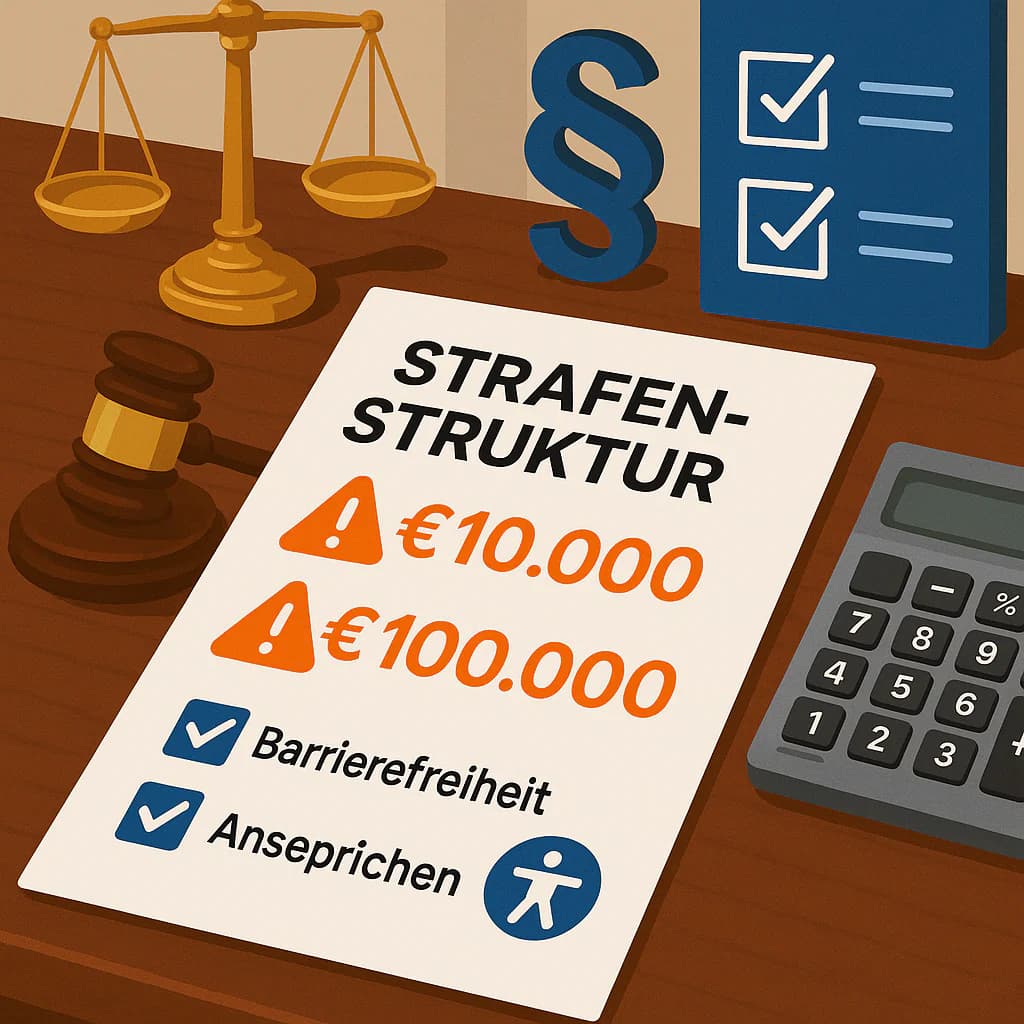
EAA Fines: €10,000 to €100,000 - What Really Threatens?
Detailed analysis of EAA fines: amounts, enforcement, first proceedings. What companies really face with non-compliance - with concrete case examples.
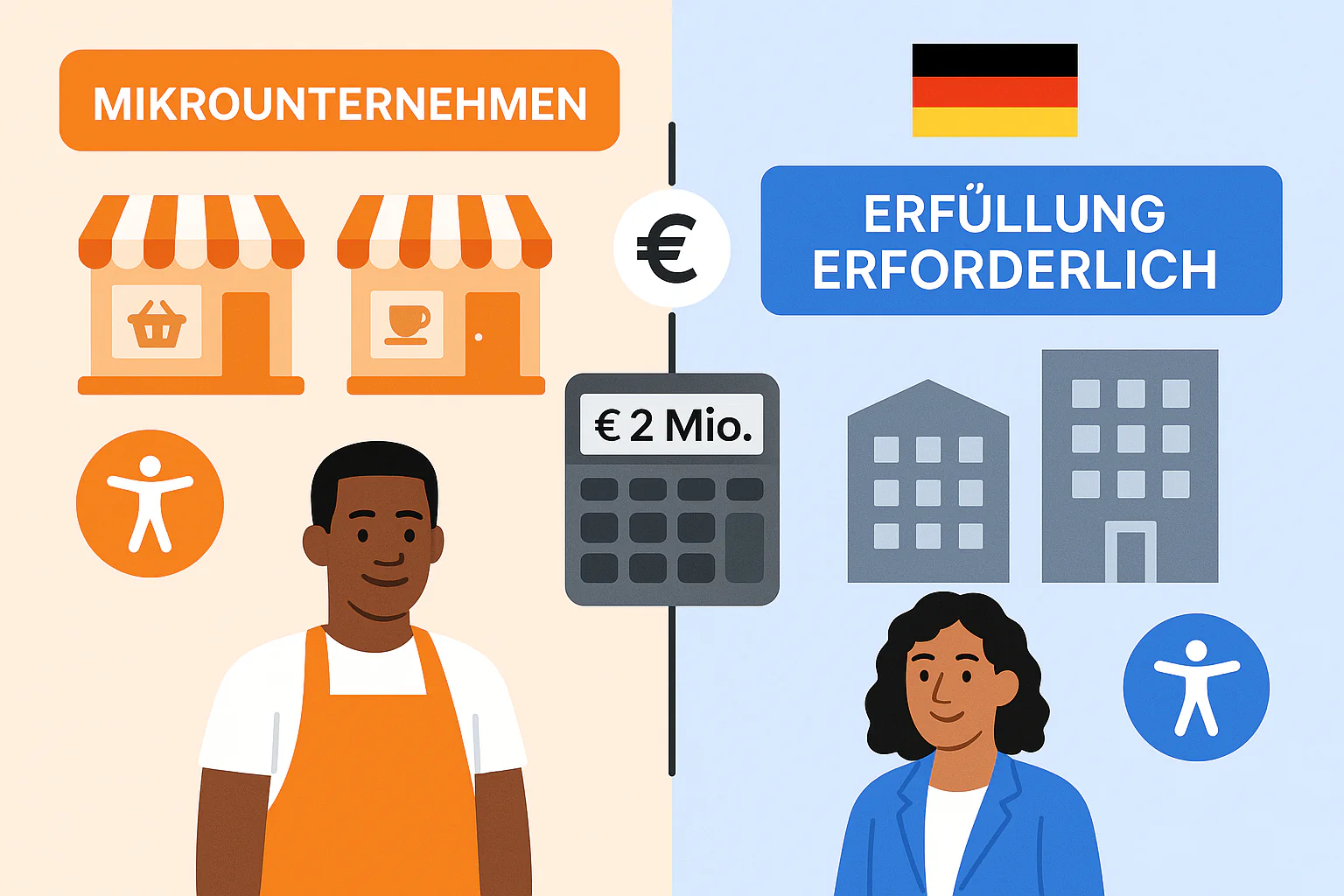
Who is Affected by the EAA? The €2 Million Threshold Explained
Detailed analysis of EAA applicability: microenterprise exception, thresholds, special cases. Clear answers for SMEs about the €2 million threshold.
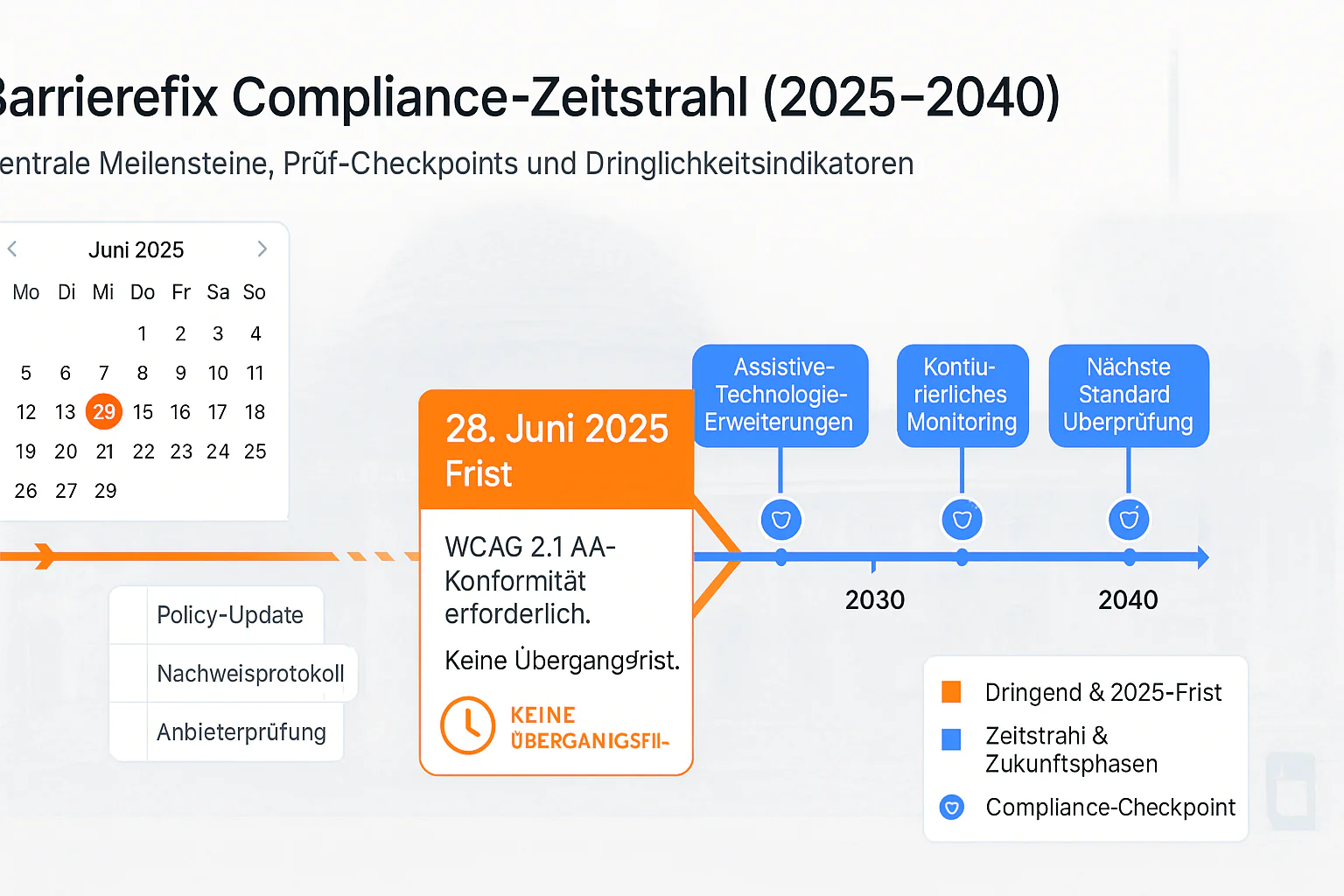
When Does What Apply? The EAA Timeline 2025-2040
Complete EAA timeline: June 28, 2025 for websites, 2030 for existing contracts, 2040 for terminals. All deadlines, transition periods and key dates at a glance.