Who is Affected by the EAA? The €2 Million Threshold Explained
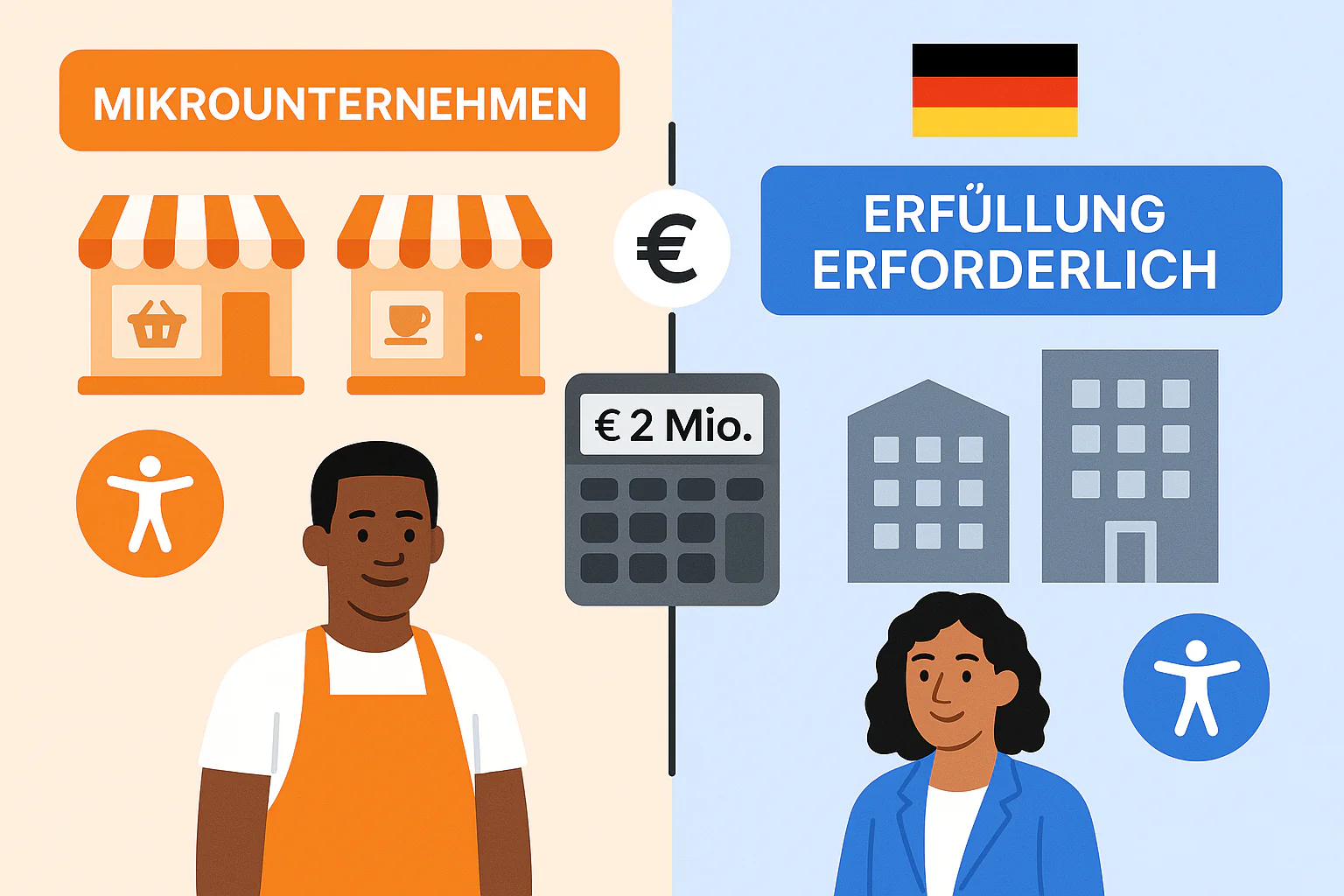
Note: While this article focuses on Germany's implementation of the European Accessibility Act (BFSG), similar microenterprise exceptions apply across the EU under Directive 2019/882, though specific thresholds may vary by member state.
The most common question from entrepreneurs about the EAA is: "Am I even affected?" The answer is more complex than thought, because the law distinguishes between product manufacturers and service providers, knows thresholds for microenterprises, and makes exceptions that have exceptions. This detailed analysis brings clarity to the confusion[1][2].
Quick Check: Are You Affected?
The Basic Rule: B2C Business = EAA Applicability
The EAA basically applies to all companies that offer digital products or services to consumers. The key term is "to consumers" - B2B services are exempt[3].
✅ Definitely Affected (without exception):
- E-Commerce of any size: Online shops, marketplaces, booking portals
- Financial services for consumers: Online banking, insurance, PayPal etc.
- Telecommunications providers: Mobile, internet, VoIP, messaging
- Streaming and media: Netflix, Spotify, YouTube (commercial channels)
- Transport and mobility: Railway apps, Uber, taxi apps
- Healthcare: Doctor appointment apps, online pharmacies
❌ Not Affected:
- Pure B2B providers: CRM software only for businesses, industrial equipment
- Internal tools: Employee portals, intranet systems
- Public institutions: Already regulated by BITV 2.0 (German Accessibility Regulation)
The €2 Million Threshold: Microenterprise Exception in Detail
Here it gets complicated: The EAA has an exception rule for microenterprises, but this only applies to service providers, not product manufacturers[4].
Microenterprise Exception (§ 3 Para. 3 BFSG):
A company is exempt from the service directive as a microenterprise if it meets both criteria:
| Criterion | Threshold | Calculation Basis |
|---|---|---|
| Employees | < 10 persons | Full-time equivalents, annual average |
| Finances | < €2 million | Annual revenue or balance sheet total |
⚠️ Critical Exception: Product Manufacturers
Even microenterprises must manufacture EAA-compliant products! The exception only applies to service providers[5].
Example Scenarios:
Scenario 1: Online Shop (5 employees, €800k revenue)
- ✅ Exception: Is microenterprise, operates only service (shop platform)
- Result: Not EAA-required
Scenario 2: App Developer (8 employees, €1.5 million revenue)
- ❌ No Exception: Manufactures software products for consumers
- Result: Fully EAA-required
Scenario 3: Consulting Agency with own CMS (12 employees)
- ❌ No Exception: Exceeds employee threshold
- Result: Fully EAA-required
Service Providers vs. Product Manufacturers: The Decisive Distinction
The EAA treats service providers and product manufacturers completely differently. This distinction decides your applicability.
Service Providers (can use microenterprise exception):
- Online Platforms: Mediation between third parties
- Software-as-a-Service: Cloud-based applications without standalone software
- Financial Services: Banking, insurance, payment processing
- Telecommunications: Internet, phone, messaging services
Product Manufacturers (no microenterprise exception):
- Software Development: Apps, programs, browser extensions
- Hardware Products: Computers, smartphones, terminals
- E-Books and digital media: Standalone digital content
- Medical Devices: Apps for health purposes
Gray Zone: Hybrid Companies
Many companies are both service providers and product manufacturers. An online shop with its own app, for example, is active in both categories. In such cases, the stricter product manufacturer rules apply.
Concrete Applicability Matrix: 15 Typical Company Types
| Company Type | Employees | Revenue | Category | EAA Obligation |
|---|---|---|---|---|
| Freelancer Shop | 1 | €300k | Service provider | ❌ Exempt |
| Startup E-Commerce | 8 | €1.5M | Service provider | ❌ Exempt |
| Mid-sized Retailer | 25 | €5M | Service provider | ✅ Required |
| App Developer (Small) | 5 | €800k | Product manufacturer | ✅ Required |
| SaaS Startup | 12 | €2.5M | Service provider | ✅ Required |
| Online Bank | 45 | €15M | Service provider | ✅ Required |
| Software Company | 3 | €500k | Product manufacturer | ✅ Required |
| Streaming Service | 8 | €1.2M | Service provider | ❌ Exempt |
| Gaming Studio | 15 | €3M | Product manufacturer | ✅ Required |
| Telecom Provider | 200 | €50M | Service provider | ✅ Required |
| Hardware Startup | 6 | €900k | Product manufacturer | ✅ Required |
| Fitness App | 4 | €400k | Product manufacturer | ✅ Required |
| Booking Portal | 18 | €4M | Service provider | ✅ Required |
| B2B Software | 35 | €8M | Not B2C | ❌ Not affected |
| Media Startup | 9 | €1.8M | Product manufacturer | ✅ Required |
Special Cases and Gray Areas
Case 1: Franchise Companies
Problem: Is the franchisee or franchisor responsible? Solution: Both are affected - the franchisor for the system software, the franchisee for their local online presence.
Case 2: Marketplace Sellers
Problem: Must the seller be EAA-compliant on third-party platforms (Amazon, eBay)? Solution: No, the platform is responsible. Own websites must be compliant, however.
Case 3: White-Label Services
Problem: Who is responsible - the provider or the white-label partner? Solution: Whoever sells the service under their own name to consumers.
Case 4: International Companies
Problem: Does EAA apply to foreign providers with German customers? Solution: Yes, if they offer services to German consumers.
✅ Practical Tip: The 3-Question Test
1. Do you sell directly to end customers (B2C)?
2. Do you manufacture software/apps or only provide services?
3. Do you have more than 10 employees or €2 million revenue?
If all answers are "Yes": You are definitely EAA-required.
Avoiding Common Misjudgments
Myth 1: "Small companies are generally exempt"
❌ False. Product manufacturers are affected regardless of size.
Myth 2: "B2B sector is completely EAA-free"
❌ Imprecise. B2B providers can also be affected if they additionally conduct end customer business.
Myth 3: "Only German companies must follow EAA"
❌ False. All providers serving German consumers are affected.
Myth 4: "Marketplace sellers are automatically exempt"
❌ Partially false. Only on the platform itself - own websites must be compliant.
Applicability Checklist for Your Company
Step 1: Analyze Business Model
- Do we sell directly to end customers?
- Do we provide our own software/apps?
- Do we operate our own website/app for customers?
- Do we only offer B2B services?
Step 2: Check Company Size
- Fewer than 10 full-time employees?
- Annual revenue under €2 million?
- Balance sheet total under €2 million?
- Are we pure service providers (no product manufacturing)?
Step 3: Determine Applicability
- Not affected: Pure B2B business
- Exempt: Microenterprise + pure service provider
- Fully affected: All other constellations
Step 4: Plan Next Steps
- WCAG audit of existing website
- Budget for accessibility implementation
- Timeline until June 28, 2025
- Legal consultation for uncertainties
Frequently Asked Questions (FAQ)
I have 8 employees and €1.8 million revenue. Am I affected as an online shop?
No, you fall under the microenterprise exception, since you fall below both thresholds and are active as a pure service provider (shop operator).
We develop apps with 6 employees and €900k revenue. Are we exempt?
No, you are affected. As a product manufacturer (app development), the microenterprise exception does not apply, regardless of your size.
Does the €2 million threshold apply to revenue or profit?
To annual revenue (total proceeds) or alternatively the balance sheet total. Profit is not relevant for the EAA thresholds.
We are a B2B provider but also have a customer website. Are we affected?
If the website only contains information (no sales/service for end customers), you are not affected. With end customer services, yes.
What happens if we exceed the thresholds during the year?
The assessment occurs at the deadline June 28, 2025. If you exceed the values then, you are required from that point.
Do the thresholds apply to group companies individually or jointly?
Each legally independent company is assessed individually. Group structures don't change the individual thresholds.
We only sell via Amazon/eBay. Do we still have to be EAA-compliant?
No, for sales on third-party platforms, the platform is responsible. Own websites/apps must be compliant, however.
Can the applicability status change after 2025?
Yes, through company growth, business model changes or new case law, the status can change.
Next Steps: From Analysis to Implementation
Now you know your EAA status. If you're affected, quick action is required. The next step is a professional WCAG analysis of your digital offerings.
Our recommendation: Let us assess your specific situation together and develop a customized compliance plan.
Further EAA Articles:
Free audit of your website
Let us check your website for accessibility – free and non-binding
Topics:
BFSG-ClusterVertiefen Sie Ihr Wissen
Weitere Artikel
European Accessibility Act 2025: The Ultimate SME Compliance Guide
Complete EAA guide for small and medium enterprises. Who's affected, what penalties apply, and how to become compliant by June 28, 2025.
Shopware 6 Accessibility: EAA Compliance Guide for E-Commerce
Shopware 6.7 Accessibility Guide 2025: Built-in WCAG 2.1 Features, EAA Compliance, B2B Features - Achieving Perfect 100/100 Lighthouse Score.
When Does What Apply? The EAA Timeline 2025-2040
Complete EAA timeline: June 28, 2025 for websites, 2030 for existing contracts, 2040 for terminals. All deadlines, transition periods and key dates at a glance.