How Accessibility Improves SEO: The Complete Guide 2026
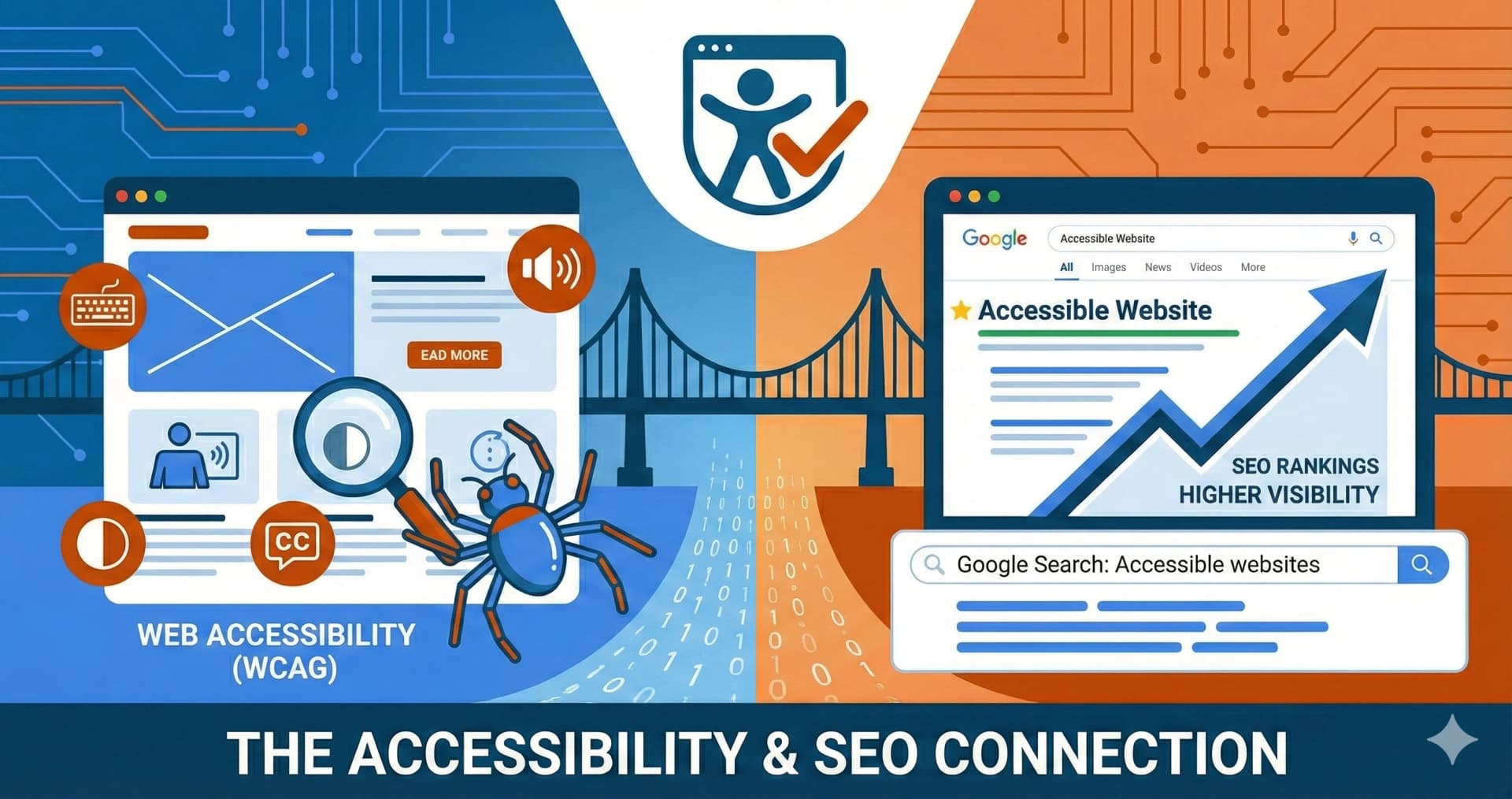
Accessible websites rank higher in Google. That's not opinion – it's data. A 2025 study of 10,000 websites found that WCAG-compliant sites gained 23% more organic traffic and ranked for 27% more keywords than non-compliant sites[1]. This guide explains exactly why accessibility and SEO are deeply connected – and how improving one automatically improves the other.
Key Statistics
- 23% more organic traffic for WCAG-compliant sites (Semrush study)
- 27% more keywords ranking for accessible websites
- 12% average traffic increase within 3 months of accessibility fixes
- 73% of sites saw traffic growth after implementing accessibility
- 41% improvement in crawl efficiency from proper heading structure
Why Accessibility and SEO Are Connected
Here's the fundamental truth: Google's crawler is essentially blind. Googlebot can't "see" your website like a human does. It parses HTML, interprets structure, and understands content programmatically – exactly like a screen reader does[2].
This means that many accessibility best practices directly help search engines understand your content:
| Accessibility Practice | How It Helps SEO |
|---|---|
| Alt text for images | Helps Google understand image content for ranking |
| Semantic HTML | Creates clear structure for crawlers |
| Descriptive headings | Builds content hierarchy for indexing |
| Link text (not "click here") | Provides context for internal linking |
| Video transcripts | Makes video content indexable as text |
| Page titles | Critical for both screen readers and SERPs |
| Keyboard navigation | Ensures all content is crawlable |
| Mobile responsiveness | Core ranking factor in mobile-first indexing |
The Research: Data-Backed Evidence
Semrush Study: 10,000 Websites Analyzed
In 2025, Semrush partnered with AccessibilityChecker.org and BuiltWith to analyze the SEO performance of 10,000 websites based on their accessibility compliance[3].
Results:
| Metric | WCAG-Compliant Sites | Non-Compliant Sites |
|---|---|---|
| Organic Traffic | +23% | Baseline |
| Keywords Ranked | +27% | Baseline |
| Authority Score | +19% | Baseline |
847-Website Implementation Study
A separate study tracked 847 websites that implemented accessibility fixes[4]:
- 73.4% saw traffic growth after implementing accessibility solutions
- 66.1% increased monthly organic traffic by 1-50%
- 7.3% saw increases of more than 50%
- Average traffic increase: 12% within 3 months
Google's September 2025 Algorithm Update
After Google's September 2025 core update, websites meeting high accessibility standards reported a 37% average increase in organic traffic[5].
Get Your Accessibility & SEO Audit
We'll show you exactly where accessibility improvements can boost your rankings
Book Free ConsultationCase Studies: Real Results
CNET: 30% Traffic Increase from Video Transcripts
CNET added transcripts to their video content, making it accessible to deaf users and those who prefer reading. Result: 30% increase in Google search traffic[6].
Why it worked: Google can't "watch" videos. Transcripts make video content indexable as text, creating more keyword opportunities.
Tesco: £35,000 Investment → £13 Million in Sales
UK retailer Tesco invested £35,000 in accessibility improvements to their website. The result was a dramatic increase to £13 million in annual online sales[7].
E-Commerce Retailer: 50% Traffic, 30% Sales
A major e-commerce retailer undertook a complete accessibility overhaul including:
- Improved keyboard navigation
- Better form labeling
- More descriptive product images
Results: 50% increase in organic traffic and 30% increase in online sales[8].
The 10 Areas Where Accessibility and SEO Overlap
1. Alt Text for Images
WCAG Requirement: All images need alternative text describing their content (WCAG 1.1.1)
SEO Benefit: Google uses alt text to understand image content for:
- Image search rankings
- Understanding page context
- Featured snippet selection
The problem: 55.5% of website images lack alt text[9].
Best practice:
<!-- Good: Descriptive and useful -->
<img src="product.jpg" alt="Blue wool sweater with crew neck, front view">

<!-- Bad: Generic or missing -->
<img src="product.jpg" alt="product image">
<img src="product.jpg" alt="">
2. Semantic HTML Structure
WCAG Requirement: Content structure must be conveyed programmatically (WCAG 1.3.1)
SEO Benefit:
- 41% improvement in crawl efficiency from proper heading hierarchy[10]
- Better understanding of content relationships
- Increased chance of featured snippets
Use these elements:
<header>,<nav>,<main>,<footer>for page regions<h1>to<h6>for content hierarchy<article>,<section>,<aside>for content grouping<ul>,<ol>for lists
3. Heading Hierarchy
WCAG Requirement: Headings must describe content and follow logical order
SEO Benefit:
- Helps Google understand your content's topic and structure
- Creates outline for featured snippets
- Supports topic relevance signals
Best practice:
<h1>Main Page Title (one per page)</h1>
  <h2>Major Section</h2>
    <h3>Subsection</h3>
    <h3>Subsection</h3>
  <h2>Another Major Section</h2>
4. Descriptive Link Text
WCAG Requirement: Link purpose must be clear from link text (WCAG 2.4.4)
SEO Benefit: Anchor text helps Google understand:
- What the linked page is about
- Relationships between your pages
- Context for crawling priorities
Examples:
| Accessibility (Bad) | Accessibility + SEO (Good) |
|---|---|
| Click here | Read our WCAG compliance guide |
| Learn more | Learn about accessibility audits |
| Read more | See our e-commerce accessibility checklist |
5. Page Titles
WCAG Requirement: Pages must have descriptive titles (WCAG 2.4.2)
SEO Benefit: The <title> tag is one of the most important on-page SEO factors. It directly appears in:
- Search results (SERP)
- Browser tabs
- Social shares
6. Video Transcripts and Captions
WCAG Requirement: Pre-recorded video needs captions and transcripts (WCAG 1.2.1, 1.2.2)
SEO Benefit:
- Makes video content indexable
- Creates additional keyword opportunities
- Supports featured snippets from video content
- CNET saw 30% traffic increase from transcripts
7. Mobile Responsiveness
WCAG Requirement: Content must be accessible on different screen sizes (WCAG 1.4.10)
SEO Benefit:
- Mobile-first indexing means Google primarily uses mobile version
- Core Web Vitals measured on mobile
- Direct ranking factor
8. Page Speed
WCAG Requirement: While not explicitly required, slow pages create accessibility barriers
SEO Benefit:
- Core Web Vitals are ranking factors
- Faster pages have lower bounce rates
- Better user engagement signals
9. Readable Content
WCAG Requirement: Content should be readable and understandable (WCAG 3.1)
SEO Benefit:
- Helps with featured snippets
- Improves user engagement metrics
- Supports voice search optimization
10. Form Labels
WCAG Requirement: All form inputs need associated labels (WCAG 1.3.1, 3.3.2)
SEO Benefit:
- Better user experience reduces bounce rates
- Properly labeled forms improve conversion rates
- Structured data can be derived from form content
AI Search and Accessibility
Here's the emerging connection: AI agents parse websites like screen readers do[3].
As users shift from Google to ChatGPT and Perplexity for search:
- AI models need structured, semantic content
- Clear headings help AI understand your expertise
- Accessible content is easier for AI to cite
This means accessibility is now essential for what's being called AIO (Artificial Intelligence Optimization).
The AI Connection
While non-compliant sites lost 20-30% of their traffic to AI search tools, WCAG-compliant sites maintained their visibility. Accessible, well-structured content is easier for AI to understand and cite.
Is Accessibility a Direct Ranking Factor?
Google has not confirmed WCAG compliance as a direct ranking signal. However, the characteristics that make sites WCAG compliant are things Google values and rewards[11].
Think of it this way:
- Accessibility improvements → Better structure, more content → Better SEO signals
- Accessibility improvements → Better UX → Better engagement metrics → Better rankings
The connection is indirect but powerful.
Quick Wins: Start Here
Accessibility Improvements That Boost SEO
High Impact, Easy to Implement:
- Add alt text to all images (biggest single overlap opportunity)
- Fix heading structure – use H1-H6 in logical order
- Replace "click here" with descriptive link text
- Add video transcripts to all video content
Medium Effort, High Impact:
- Implement semantic HTML – use proper landmarks
- Label all form fields properly
- Ensure mobile responsiveness
- Improve page speed (Core Web Vitals)
Frequently Asked Questions
Does Google use accessibility as a ranking factor?
Not directly. Google hasn't confirmed WCAG compliance as a ranking signal. However, accessibility improvements lead to better structure, more content, and better user experience – all of which are ranking factors.
How quickly will I see SEO results from accessibility improvements?
Research shows an average of 12% traffic increase within 3 months of implementing accessibility fixes. Some sites see results faster, especially if major issues (like missing alt text) are fixed.
Which accessibility fix has the biggest SEO impact?
Adding alt text to images is the single biggest overlap opportunity. It helps both screen reader users and Google's image understanding. With 55.5% of images missing alt text, this is often low-hanging fruit.
Can accessibility improvements hurt my SEO?
No. There's no documented case of accessibility improvements hurting SEO. The improvements are either neutral or positive for search rankings.
Should I prioritize accessibility or SEO?
You don't have to choose. Many best practices overlap. Start with the items in the "Quick Wins" section above – they improve both simultaneously.
Conclusion
The data is clear: accessible websites perform better in search. With 23% more organic traffic, 27% more keyword rankings, and improved Authority Scores, WCAG compliance is effectively an SEO strategy.
The reason is simple: search engines and assistive technologies need the same things – clear structure, meaningful labels, and well-organized content. When you optimize for one, you optimize for both.
And with AI search on the rise, this connection is only getting stronger. Accessible content is AI-friendly content.
Start today:
- Audit your images for alt text
- Check your heading structure
- Review your link text
- Add transcripts to videos
Every accessibility improvement is also an SEO improvement.
Ready to Improve Your SEO Through Accessibility?
We specialize in accessibility audits that also boost search rankings
Book Free ConsultationRelated Articles:
Free audit of your website
Let us check your website for accessibility – free and non-binding
Topics:
Weitere Artikel
How Much Does an Accessibility Audit Cost in 2026? Pricing Guide
Transparent overview of web accessibility audit costs: From €1,500 to €20,000+ depending on scope. Learn the 7 factors that influence pricing and how to choose the right provider.
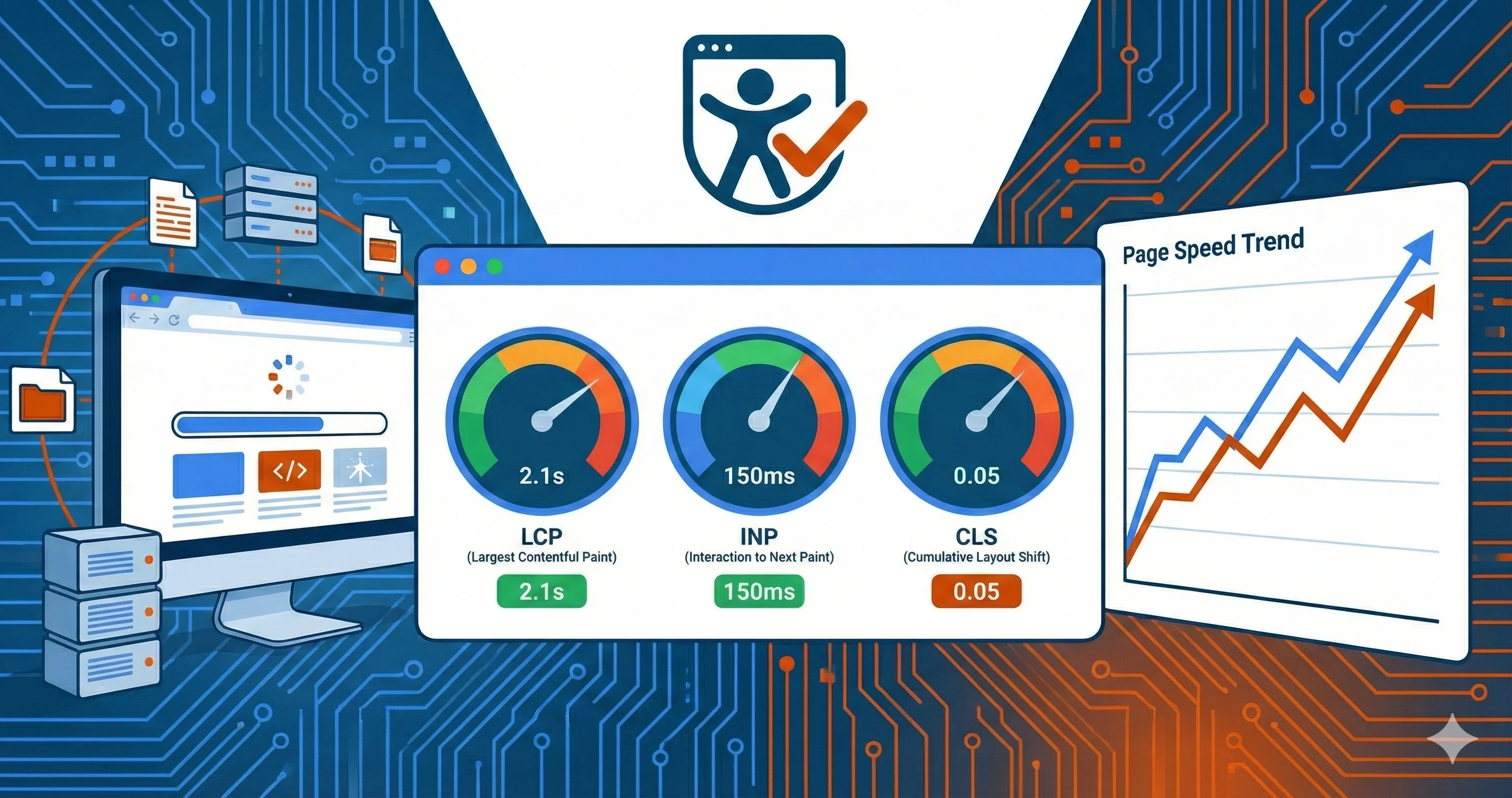
Core Web Vitals 2026: The Complete LCP, INP, and CLS Optimization Guide
Master Core Web Vitals in 2026 with this comprehensive guide. Learn the current thresholds for LCP, INP, and CLS, optimization techniques, tools, and why only 47% of websites pass.
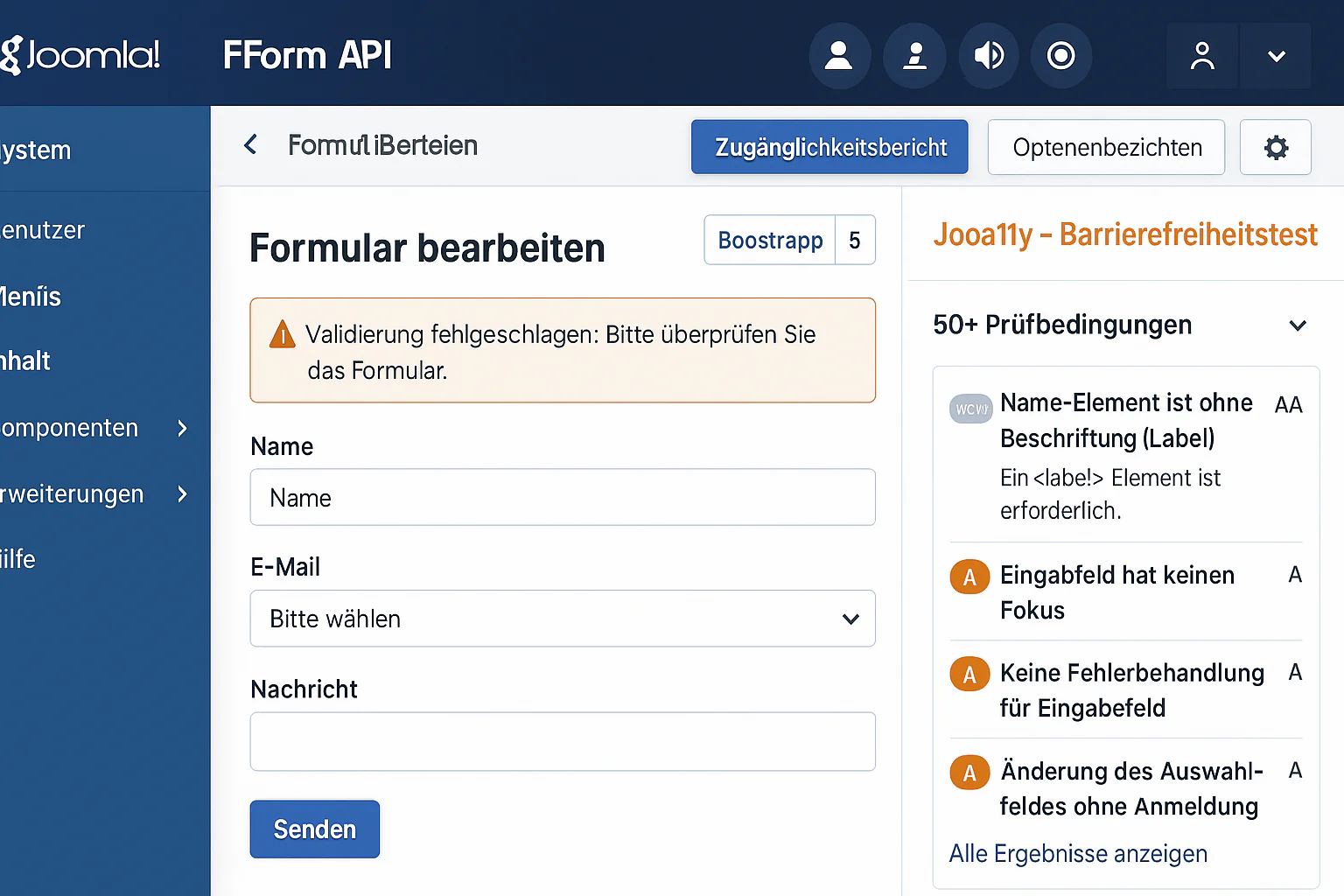
Joomla 4 & 5 Form Accessibility: WCAG Compliance Guide
Joomla 4/5 Accessibility Guide 2025: JForm API, Jooa11y Checker, RSForm Pro WCAG - Bootstrap 5 Integration for complete accessibility compliance.