BFSG Inspections 2026: How German Authorities Check Your Website

BFSG enforcement is real: Since September 2025, Germany's MLBF (Market Surveillance Authority for Accessibility) actively inspects websites and digital services for accessibility compliance. Starting January 2026, inspections are intensifying and documentation requirements are being strictly enforced. This article explains exactly how authorities inspect, what they check, and how you can prepare.
Key Takeaways
- The MLBF in Magdeburg has been the central enforcement authority since September 26, 2025
- Inspections occur through random sampling and complaint-based reviews
- Two inspection types: formal (documentation) and substantive (actual accessibility)
- From 2026, documentation requirements are being actively enforced
- Violations can result in fines up to €100,000 and sales bans
The MLBF: Who Enforces BFSG Compliance?
The Marktüberwachungsstelle der Länder für die Barrierefreiheit (MLBF) – Market Surveillance Authority for Accessibility – is Germany's central enforcement body for the BFSG. All 16 German federal states agreed on this unified solution to ensure consistent enforcement across the country.
MLBF Contact Information:
| Information | Details |
|---|---|
| Address | Carl-Miller-Str. 6, 39112 Magdeburg, Germany |
| Phone | +49 391 567 6970 |
| kontakt@mlbf-barrierefrei.de | |
| Operational Since | September 26, 2025 |
| Staff | 70-100 employees (planned) |
Why a Central Authority?
The MLBF provides:
- Unified Standards: Same evaluation criteria across all federal states
- Specialization: Staff with expertise in digital accessibility
- Efficiency: No duplicate inspections by different state authorities
- Legal Certainty: Clear point of contact for businesses
Prepare for BFSG Compliance
We help businesses navigate German accessibility requirements
Book Free ConsultationTwo Types of Inspections: Formal and Substantive
The MLBF distinguishes between two control types that examine different aspects of your BFSG compliance.
1. Formal Inspection (Document Review)
In formal inspections, your documentation and declarations are reviewed:
Documents Checked:
- ✅ Accessibility conformity declaration
- ✅ Technical documentation per BFSG Annex 2
- ✅ Disproportionality waiver evidence (if claimed)
- ✅ Accessibility statement on the website
- ✅ Feedback mechanism for user reports
Common Deficiencies:
- Missing or incomplete conformity declaration
- No publicly accessible accessibility statement
- Outdated documentation
- Non-functional feedback mechanism
2. Substantive Inspection (Practical Testing)
Substantive inspections verify whether your website or app is actually accessible in practice:
Testing Methods:
- Automated WCAG scans of the entire website
- Manual testing with screen readers (NVDA, JAWS)
- Keyboard-only navigation testing
- Color contrast and text size verification
- Form testing with assistive technologies
Important to Know
Automated tests can only check approximately 30% of WCAG criteria. The MLBF also conducts manual tests to identify complex barriers that automated tools cannot detect.
When and How Are Inspections Conducted?
The MLBF conducts inspections through two channels:
Random Sampling (Proactive)
The authority selects businesses based on:
- Industry Focus: E-commerce, banking, and insurance prioritized
- Company Size: Larger providers inspected more frequently
- Random Selection: Smaller providers can be inspected at any time
- Market Significance: High-traffic websites receive focus
Complaint-Based Inspections (Reactive)
Anyone can report violations:
- Consumers with disabilities
- Consumer protection organizations
- Competitors
- Disability advocacy groups
Once a complaint is filed, the MLBF must investigate – they have no discretion to decline.
The Inspection Process: Step by Step
Phase 1: Initial Contact and Document Request
- Written notification from the MLBF
- Response deadline (typically 2-4 weeks)
- Document requests:
- Conformity declaration
- Technical documentation
- Evidence of measures taken
Phase 2: Review
| Step | Duration | What Happens |
|---|---|---|
| Automated Scan | 1-2 days | Tool-based WCAG testing |
| Document Review | 3-5 days | Analysis of submitted materials |
| Manual Testing | 5-10 days | Screen reader, keyboard, contrast checks |
| Evaluation | 3-5 days | Summary of findings |
Phase 3: Results and Actions
If Compliant:
- No further action required
- Positive result documented
If Non-Compliant:
- Remediation request (deadline: typically 4-8 weeks)
- Follow-up inspection after deadline
- Continued non-compliance: Fine proceedings initiated
Pro Tip: Use the Remediation Period
Businesses that achieve full compliance during the remediation period often face significantly reduced or no fines at all. Respond immediately and cooperatively!
Documentation Requirements from 2026
Starting January 2026, the MLBF is strictly enforcing documentation requirements. This means:
What You Must Document:
-
Accessibility Statement (public on your website)
- Conformity status
- Non-compliant content with explanation
- Feedback options and contact details
- Date of last review
-
Internal Documentation (provided upon request)
- Accessibility tests performed
- Identified barriers and remediation measures
- Staff training records
- Improvement timeline
-
Technical Documentation (per BFSG Annex 2)
- Description of accessibility features
- Standards applied (WCAG, EN 301 549)
- Audit reports and test results
Missing Documentation = Fines
| Documentation Gap | Potential Fine |
|---|---|
| No accessibility statement | €10,000 - €30,000 |
| Incomplete technical documentation | €10,000 - €50,000 |
| No feedback mechanism | €5,000 - €20,000 |
| Failure to cooperate with authority | €20,000 - €100,000 |
How to Prepare for Inspections
BFSG Inspection Checklist
Documentation:
- Accessibility statement published on website
- Feedback form for barrier reports set up
- Technical documentation created and current
- Conformity declaration available
Technical Implementation:
- WCAG 2.1 Level AA conformance verified
- Automated tests run regularly
- Screen reader testing completed
- Full keyboard navigation working
Organization:
- Accessibility responsible person designated
- Team trained on WCAG
- Process for barrier reports defined
- Regular audits scheduled
What to Do During an Inspection
- Stay calm: Inspections are normal, don't panic
- Cooperate: Provide quick and complete responses
- Meet deadlines: Take all timelines seriously
- Document: Prove your remediation efforts
- Get expert help: Bring in consultants for complex cases
Additional Enforcement Channels
Beyond the MLBF, other actors can pursue BFSG violations:
Competition Law Warnings
The BFSG qualifies as a market conduct rule under German unfair competition law (UWG). This means:
- Competitors can send cease-and-desist letters
- Consumer protection associations can sue
- Warning costs add to potential fines
Civil Litigation
Affected individuals can:
- Sue for injunctive relief
- Demand removal of barriers
- Potentially claim damages
Frequently Asked Questions
How likely is an inspection of my business?
Likelihood depends on industry and size. E-commerce, banking, and large platforms are prioritized. However, smaller providers can be targeted at any time through complaints.
Are inspections announced in advance?
Formal inspections typically begin with a document request. However, random website scans can occur without warning.
What happens if I miss a response deadline?
A missed deadline is considered lack of cooperation and can lead to higher fines. Contact the authority proactively if you need an extension.
Can I appeal a fine?
Yes, you can file a written objection within 2 weeks of receiving the notice. Success rates are good for procedural errors by the authority.
Are micro-enterprises exempt from inspections?
No, but micro-enterprises (under 10 employees AND under €2 million turnover) are exempt from service-related requirements. Product manufacturers must still comply regardless of size.
Conclusion: Act Proactively
BFSG inspections are not a theoretical threat – they're happening. Businesses that act now have clear advantages:
- No fines: Compliance before inspection protects you
- Better negotiating position: Documented efforts are viewed positively
- Competitive advantage: Accessible websites reach more customers
Don't wait for the first inspection. Have your website checked for BFSG compliance now and close gaps before authorities find them.
Get Your BFSG Compliance Check
We'll assess your website's readiness for German accessibility inspections
Book Free ConsultationRelated Articles:
Free audit of your website
Let us check your website for accessibility – free and non-binding
Topics:
Weitere Artikel
Shopware 6 Accessibility: EAA Compliance Guide for E-Commerce
Shopware 6.7 Accessibility Guide 2025: Built-in WCAG 2.1 Features, EAA Compliance, B2B Features - Achieving Perfect 100/100 Lighthouse Score.
WordPress Accessible Product Page: WooCommerce WCAG Guide
WooCommerce 10.0 WCAG 2.2 Compliance Guide 2025: Themes, Plugins, Checkout, Payment Gateways - Properly Configuring 140+ Accessibility Features.
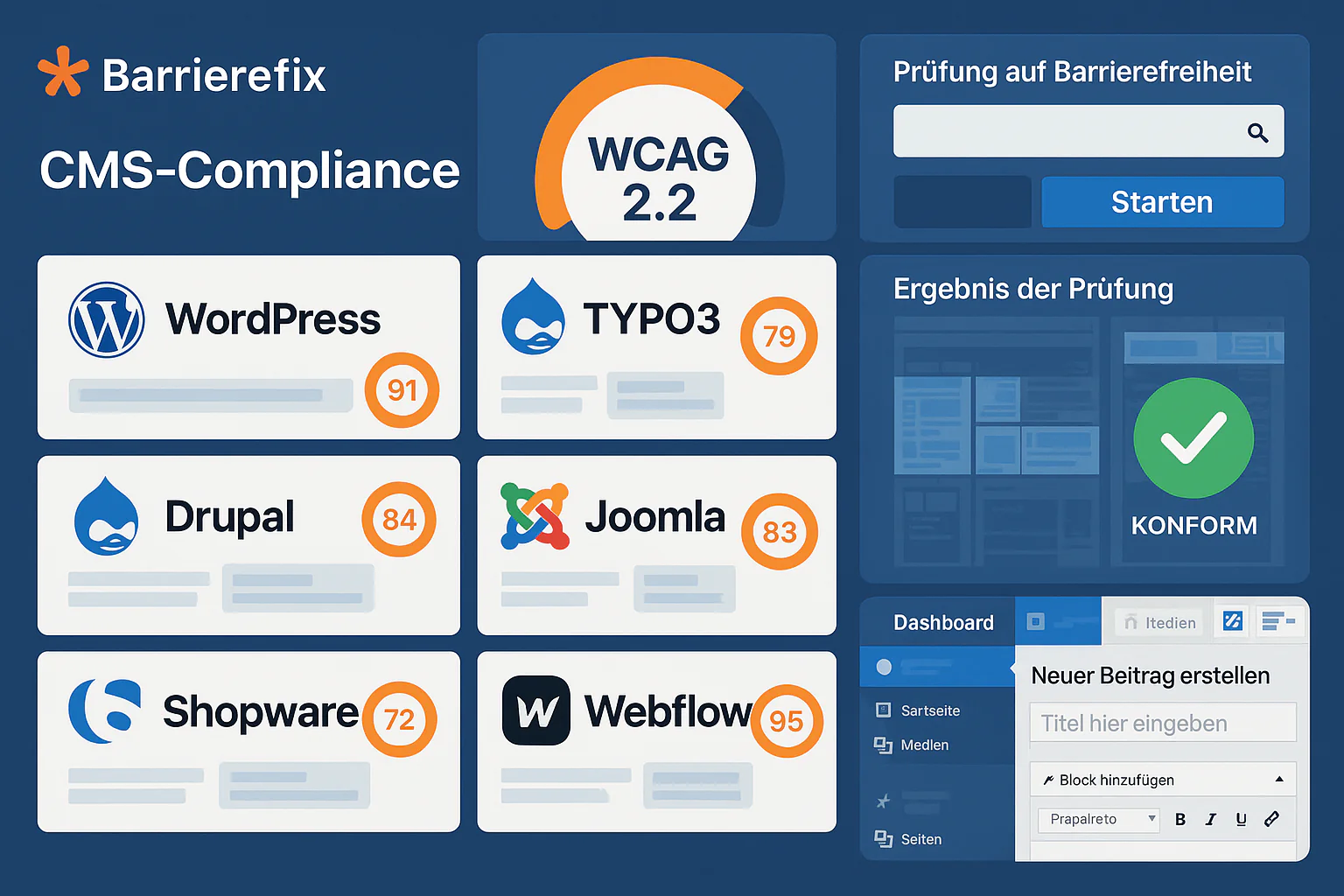
Web Accessibility for All CMS Systems: The Practical Guide
Complete CMS accessibility comparison 2025: WordPress, TYPO3, Drupal, Joomla, Contao. WCAG compliance, costs, plugin ecosystem and BFSG readiness for German companies.